Was to the Thyseen Museum on Sunday in Madrid. I chose it because my guide book described it as a lesson in art history. And indeed it was. So what follows is my general outline of the history of art.
It started in medieval times with religious paintings of important figures in Christianity in medieval clothing. Then sometime in the late 1400's portraits became a thing, dark ones. The religious painters found some colours other than reds and golds - blue, for example - and the portrait guys followed suit.
Then, sometime in the 1600's, the Dutch and the Italians started painting landscapes and buildingscapes, usually in darker colours. The portraits continued, with rich people in more elaborate dress, sometimes posed to emulate someone in mythology.
In the late 1700's someone (Dutch again, I think) thought it would be cool to paint some fruit really, really well. Then the French painters said "Moi aussi!" This is when I noticed the effects of light were becoming more interesting and realistic - paintings appeared to have depth. The portraits continued, new and improved with lighting.
Some people started painting sentimental pictures of peasants. In the late 1800's the French stepped away from fruit for a while (although not completely) and so began the Impressionists and their ilk (post-impressionists, colourists, fauvists, etc. - I've read all sorts of terms but can't place them all). This is the art that I like the best. I'm very impressed by how a blotch of this colour here and this colour there, placed seemingly haphazardly, can form an amazing picture. I also really like how the light is captured in thse paintings (I have a thing for light, it seems).
In the early 1900's it all went weird. You go from Cubism with some recognizable shapes to what I would call abstract painting. I just don't get this stuff. Now, maybe these paintings are making reference to other periods in art history and because I don't know art well enough, I don't "get" them as a consequence. This idea occurred to me after Rob, the master of ceremonies at Vaughan Town, explained to me that post-modern art is art that refers to other art).
This would be analogous to, say, comedic television in the 1990's and on. The Simpsons, for example, is only truly funny if you understand all the numerous historical pop-culture references that it makes. Ditto for Family Guy (television history references) and the now-cancelled Futurama (science and science fiction references).
If a person from another time were to watch those shows, they would probably not find them very funny, whereas early television comedy, say "I Love Lucy", was more slapstick and probably more generally accessible, I think. Television had to wait a few decades to have enough material to be self-referential.
So in the same way that I don't know medieval symbology or religious lore well enough to get stained glass windows in cathedrals, perhaps I don't know art well enough to get post 1900's art.
On a final art note: I'm surprised how bothered people are today by women in skimpy tops, because if art of the 1400-1500's is accurate, women were falling out of their tops completely in those times. I learned on my first European trip that in museums the proper word to describe such clothing is "flimsy."
Tuesday, May 22, 2007


Back from Vaughan Town
The light in Spain makes colours so lively. Here's a building in Madrid's Plaza Mayor. Look at that red!
And here, at the hotel Gredos.
 Vaughan Town folks hanging out at the river.

Being from an island that is essentially a big sand dune, I don't think I will ever ceased to be impressed by rocks, especially when you have so many of them that you just pile them into a fence. This is on the road outside the hotel.

Look at that red! And here, at the hotel Gredos.
Vaughan Town folks hanging out at the river.Being from an island that is essentially a big sand dune, I don't think I will ever ceased to be impressed by rocks, especially when you have so many of them that you just pile them into a fence. This is on the road outside the hotel.
Vaughan Town was interesting in two respects. I got to meet loads of Spanish people, a nationality I've not encountered frequently. And I had hour-long conversations with people, over-and-over again. It's not too often in everyday life that you spend that long speaking with just one person. As a result, I got to know many people very well in a short period of time. And I have to mention my fellow anglophones, who I had a great time with as well.
Prior to this experience, I must admit, my stereotype of Spanish people was that they are very emotional - similar to how I imagine Italians. I also held the idea of the macho-male, as well as the gregariousness in general for Spanish people. I have only really known one Spanish person up to the point I went to Vaughan Town, and that is Victor, the chef at the Coylet. As anyone who knows Victor can attest (and if you're reading this Victor, don't worry, I love you all the same for your ranting), Victor has a tendancy to passionate expression on certain issues, that wouldn't actually contradict my stereotype.
In the course of the last week I had discussions with 14 different Spanish people learning English, plus Carmen, the program director. And not one of them was that gregarious, over-the-top stereotype. In fact, I would say that the Spaniards started off the week more reserved than any of us anglophones, and being with us brought them a bit more out of their shells. Underneath the quiet reserve were friendly, funny people.
The machoness wasn't there, although there is still more chivalry - try as I may, I could not get a Spanish man to walk through a door that I held open for him, or let me bring him a drink from the bar.
I discussed the stereotype that I had held with some of the Spanish people. It seems that they also have that impression of the Italians. They also seem to have similar stereotypes of the French to what we have in Canada. Maybe I need a week in each of those countries to prove or disprove the stereotypes - I know I've definitely met loads of friendly French people, but also some not so friendly.
My general view of stereotyping is that cultures do tend to produce a certain mentality in their subjects, but there are always exceptions. As I've often put it, every country has its arseholes. If you meet just one person from a country, you never know if you've met the exception or the rule or somewhere in between. Unfortunately, people often treat any foreigner as an example of that country, even if that person probably shouldn't be.
For interests sake, I asked the Spaniards what their stereotypes of Canadians are, but they don't seem to have any. We're the country that no one in the world really thinks about. Many of them had never spoken extensively to a Canadian before meeting myself and the other Canadian girl at Vaughan Town.
I had a really good time last week, so good I'm going back the first week of July. Now I just need to find similar free experiences in other countries...
Oh, and if you'd like to see the people I spent the week with, and the place, everyone's been putting photos up on this album, so have a gander if you so desire.
Prior to this experience, I must admit, my stereotype of Spanish people was that they are very emotional - similar to how I imagine Italians. I also held the idea of the macho-male, as well as the gregariousness in general for Spanish people. I have only really known one Spanish person up to the point I went to Vaughan Town, and that is Victor, the chef at the Coylet. As anyone who knows Victor can attest (and if you're reading this Victor, don't worry, I love you all the same for your ranting), Victor has a tendancy to passionate expression on certain issues, that wouldn't actually contradict my stereotype.
In the course of the last week I had discussions with 14 different Spanish people learning English, plus Carmen, the program director. And not one of them was that gregarious, over-the-top stereotype. In fact, I would say that the Spaniards started off the week more reserved than any of us anglophones, and being with us brought them a bit more out of their shells. Underneath the quiet reserve were friendly, funny people.
The machoness wasn't there, although there is still more chivalry - try as I may, I could not get a Spanish man to walk through a door that I held open for him, or let me bring him a drink from the bar.
I discussed the stereotype that I had held with some of the Spanish people. It seems that they also have that impression of the Italians. They also seem to have similar stereotypes of the French to what we have in Canada. Maybe I need a week in each of those countries to prove or disprove the stereotypes - I know I've definitely met loads of friendly French people, but also some not so friendly.
My general view of stereotyping is that cultures do tend to produce a certain mentality in their subjects, but there are always exceptions. As I've often put it, every country has its arseholes. If you meet just one person from a country, you never know if you've met the exception or the rule or somewhere in between. Unfortunately, people often treat any foreigner as an example of that country, even if that person probably shouldn't be.
For interests sake, I asked the Spaniards what their stereotypes of Canadians are, but they don't seem to have any. We're the country that no one in the world really thinks about. Many of them had never spoken extensively to a Canadian before meeting myself and the other Canadian girl at Vaughan Town.
I had a really good time last week, so good I'm going back the first week of July. Now I just need to find similar free experiences in other countries...
Oh, and if you'd like to see the people I spent the week with, and the place, everyone's been putting photos up on this album, so have a gander if you so desire.
How I Lost My Blog
You may have noticed, or not, that there was no blog at this address for a while. That is because, while trying to make some changes from an internet cafe in Madrid on Sunday, I accidentally deleted my blog.
When I log into Blogger, I've been getting all Spanish instructions, and I know how to make a new post from memory but changing anything else involves reading Spanish, which it seems I don't do as well as I think.
So I accidentally hit a button that said "delete everything", and then it took me a while to realize that everything was gone and even longer to figure out how to get help on it. I e-mailed the Blogger help people and from the help of one with the moniker Danish, you are now able to read what I have written once again. Hurray!
I had two posts written up on Sunday, ready to go, so I'll put those ones up first and then get to the present, which is me in Granada.
When I log into Blogger, I've been getting all Spanish instructions, and I know how to make a new post from memory but changing anything else involves reading Spanish, which it seems I don't do as well as I think.
So I accidentally hit a button that said "delete everything", and then it took me a while to realize that everything was gone and even longer to figure out how to get help on it. I e-mailed the Blogger help people and from the help of one with the moniker Danish, you are now able to read what I have written once again. Hurray!
I had two posts written up on Sunday, ready to go, so I'll put those ones up first and then get to the present, which is me in Granada.
Saturday, May 12, 2007
A week of silence (probably)
I'm headed to a thing called Vaughan Town (it sounds like a cult, doesn't it) tomorrow morning in the province of Avila, west of Madrid. It's a 6-day long program that puts together 15 native English speakers with 15 Spaniards who are learning English. The idea being that people learn English best speaking to native speakers, and even better when exposed to the different accents of the English-speaking world (so I'm exposing Spanish people to a Maritimer accent - I'll have da ticken' it up a bit, eh dere b'y?). The anglophones volunteer their speaking services for the week in exchange for free accomodation and food basically. I heard about the program from Fraser who did it in October and it seems like it'll be fun. We meet for a reception tonight that involves food (tapas) and then tomorrow morning hop on a bus at 9am and arrive around noon, I believe.
So the week of silence is that there's not convenient internet access, so I probably won't be updating until I get back to Madrid (where I am now, just off the train from Portugal this morning). It won't be a week of verbal silence, since they want me to talk, and we all know that I can do that without being pressed.
On the topic of silence, it's been interesting being in countries where I don't speak the local language, namely Spanish and Portuguese. It certainly cuts down on the casual conversations that one often has with people in shops or at the train station (generally eliminates them altogether). I've been doing a lot of smiling and nodding or shrugging. My lack of comprehension didn't deter one Portuguese lady from chatting away to me for several minutes, complete with gestures and pats on the arm, of which I understood "nada".
Something I found amusing - the metro in Madrid is so old-fashioned that the signs say that seats should be reserved not only for the elderly, the disabled, and pregnant women, but also for women in general. Enforced chivalry.
Well, I'm going to find a laundromat and clean some clothes, and then perhaps check out some sights in the city.
So the week of silence is that there's not convenient internet access, so I probably won't be updating until I get back to Madrid (where I am now, just off the train from Portugal this morning). It won't be a week of verbal silence, since they want me to talk, and we all know that I can do that without being pressed.
On the topic of silence, it's been interesting being in countries where I don't speak the local language, namely Spanish and Portuguese. It certainly cuts down on the casual conversations that one often has with people in shops or at the train station (generally eliminates them altogether). I've been doing a lot of smiling and nodding or shrugging. My lack of comprehension didn't deter one Portuguese lady from chatting away to me for several minutes, complete with gestures and pats on the arm, of which I understood "nada".
Something I found amusing - the metro in Madrid is so old-fashioned that the signs say that seats should be reserved not only for the elderly, the disabled, and pregnant women, but also for women in general. Enforced chivalry.
Well, I'm going to find a laundromat and clean some clothes, and then perhaps check out some sights in the city.
Thursday, May 10, 2007
Portugal
 I've spent the week hanging around the south of Portugal, in a region known as the Algarve. I've been staying in the town of Lagos, in a room in an apartment that I've had to myself, complete with a balcony, for 11 Euros a night, so not too shabby. It's like the height of mid-summer here. It was warm in Paris and Barcelona - in the 20-degree range most days - but here it's been in the high 20's or more, and in mid-day it's scorching. I've been taking in the beach scene, from the shade, sheltering my poor pale skin from the sun in the cloudless sky, and have thus accumulated a lot more freckles (I tan in splotches!).
I travelled to the town of Silves by train one day - it's to the east of Lagos, and was the capital of Portugal in the time of the Moors. Checked out the remenants of the castle there, wandered around town, and saw oranges growing on trees for the first time in my life. Also loads of poppies growing wild. I've been in places where these things grow before, just not at the right time of year I guess.

The Sé (cathedral) in Silves:

I took the bus westward to Sagres another day, and to Capo St. Vincente, the most south-westerly point in Europe as it's touted. Looking at the far-stretching blueness of the ocean, it's hard to believe that anything lies on the other side of it, let alone a whole couple of continents.
I also went to the fort in Sagres, and walking there was a long hot trek in the sun. It didn't make me feel any better that the landscape looked like this, with tough looking plants that I wouldn't want to meet down a dark alley.

Relgion seems to be everywhere in Portugal. There's little religious statues in alcoves in walls in the streets, or pictures hanging up. There is even a major bank called Banco Esprito Sancto (or some spelling to that effect), which if my memory of Latin serves me correct, is the equivalent of Holy Ghost Bank.
I commented on the graffiti in Lisbon - well, there is still graffiti here, even in the small towns. It always puzzles me that graffiti looks the same in every country I have ever been too. Do the graffit people have a conference or something to decide on the international standard? The style of lettering is the same no matter the culture or language. It also puzzles me why graffiti artists, who are generally trying to make some attention-getting statement or demonstrate their turf and toughness, choose to use what I would call "bubble letters", a style that I associate predominantly with 10-year-old girls.
I suppose that I've only seen graffiti in the Roman alphabet - perhaps if I was to see Greek or Cyrillic or Chinese graffiti it would have a different style. Probably it would just be in bubble letters again.
Shopping for food can be an adventure over here, as labels are often in Portuguese only of course, or other languages with which I'm not overly familiar. I'm often taking a guess as to what I'm buying, and if it's labelled in German that's usually my best hope after English and French. I did stumble upon a Lidl store in Lagos, and that's helpful because the food is usually labelled in about 8 languages. For you Canadians, Lidl is a German (I believe) chain of grocery stores that are quite cheap and have an unusual, unpredictable stock. Kind of like a dollar-store of food. The most amusing thing that I saw on my recent trip was weiners (i.e. hot dogs) in some sort of clear fluid in a jar. To my further amusment, the label indicated that these were "American Way" weiners - yes, yes, hot dogs always come in jars in the States.
Lidl also has the unhappiest employees that I have ever encountered. No amount of politeness, no friendly smile can crack their icey exterior and coax out any look other than pure hatred. Maybe it's company policy that they don't smile, kind of like an anti-thesis to company policies of the likes of McDonald's and WalMart.
I do enjoy the language lessons that I get off of my multi-lingual packaging. For example, from the wrapper of my Magnum ice cream bar the other day (I now love the Ecquador dark chocolate one) I learned that in French, vanilla flavoured ice cream is "glace parfum vanille". This was news to my Canadian French, as I've always called ice cream "creme glacee" (forgive the lack of accents), and I never recall seeing the word "parfum" on any food package in Canada. Then I learned that for ice cream to be "coated" in chocolate is "uberzogen" in German, a word that strikes my fancy for some reason.
Saturday, May 05, 2007
Barecelona then Portugal
 I took an overnight train to Barcelona, getting there the morning of May 2. It was a first class bunk, just a bit roomy then the 2nd class ones really (in case you're wondering, the rail pass that I won is a 1st class ticket).
I know I said I was going to Bilbao, but I discovered that Spain is much bigger than I thought. My apologies to Spain, I should know better to assume everything is close since I'm forever telling people that Toronto is no where near the "east coast of Canada". So I stayed in Barcelona for a couple of nights. It won't rank as my favourite city in the world, since it's very packed and grubby, but it does have a lot of neat old winding streets. And palm trees, and warm weather.
I wandered around La Rambla where human statues in bizarre costumes perform - a Edward Scissorhands look-a-like snapped his scissors at me when I gave him a few coins. I went to the Market de Bourqueta for fresh fruit.
I spent an inordinate amount of time booking a ticket on a train to Lisbon, my next stop. I won't go into that, but lets just say that they could organize the train ticketing system better, and open more than 1/4 of the ticket windows.
I went to La Sagrada Familia, a cathedral under construction for over a century. It's unusual in design with natural influences, like columns that ressemble bones and trees, stair cases that are single helixes, and bunches of fruit on tops of the towers. I tried to find a park designed by the same guy, Gaudi, but with no luck. The park was supposed to have been part of a town but Gaudi never finished that either. He seemed to have trouble actualizing his ideas, or completing them. I can identify with that.


I went up to Park Montjuic and it was there that looking down on the city that I felt really disturbed. It's such a heaping of buildings, most of which aren't all that pretty. It felt stiffling looking at it. It's funny, on the street the buildings don't look too bad with their terraced windows and plant pots, but from a far it looked terrible. So I'm off mixed feelings on Barcelona.

I left there yesterday afternoon, first on a train to Madrid where I had to ride in 2nd class (gracious me!). It was actually quite comfortable, with a Lindsay Lohan film (can't remember the name - she's really lucky, then she loses her luck via kissing to a previously unlucky guy and has to get it back) that was all in Spanish so I couldn't really understand it and it was probably better that way.
Got into Lisbon this morning and had to ride from south of city to north of city to change trains. The entire city seems to be concrete apartment buildings in pale stone colours, with graffiti everywhere. It didn't seem pleasant, and after having enough of grubbiness of big cities, I was glad of my choice to go down south to Lagos, in the Algrave region. I don't know if I'll go to Lisbon to spend time at all, maybe just an afternoon before getting my train back to Madrid.
Wednesday, May 02, 2007
Things I like about Paris
Since I was hard on France in my last post, here we go.
1. Rollerbladers are not treated as though they are evil. You see all sorts of people skating in groups, playing pickup games of hockey in parks, and in general not being shunned by the world. There's lots more skaters than in Canada as well. The municipal government even mentions "rollers" on their signs about scenic river routes, as well as pedestrians and cyclists (Charlottetown Boardwalk could learn something therre).
2. Free public toilets. Important when travelling.
3. Streets that are named after someone have info on the sign about the person - it's a nice touch.
4. Fresh bread at any time of day. Unlike Scotland where it seems to sell out at noon, and that's any bread.
And in general it is a nice city as far as cities go. It's very grand, in that you can tell from the buildings, the gold paint on the fences, the sculptures of winged horses and sphinxes and what-have-you, that this is a city that has been rich for a long time and isn't afraid to show it off.
May 1 seemed to be a holiday, so all of the tourist things I had planned failed due to closures save Notre Dame cathedral. It was huge, very dark inside, quite imposing. Stained glass windows were pretty but I always have trouble figuring out what they're about due to the ornateness and the fact that I don't speak medieval religious symbology.
Afterward I wondered, discovering that everything was closed, so I made my way to the Champ de Mars, the park on which sits the Eifel Tower, and sat watching Parisian families play football and hang out.
Unlike in the UK, where people seem to obey the signs that say "No ball games" on any stretch of grass, in Paris they just play ball right by the sign. The rules seem to exist to be broken. In Notre Dame, there were signs saying not to take pictures but everyone was. One guy was setting up a huge tripod!
And a final neat thing about Paris is that I was able to speak French all day and my accent even improved over the day. So then I went to Spain where it's not of much use. Another post...
1. Rollerbladers are not treated as though they are evil. You see all sorts of people skating in groups, playing pickup games of hockey in parks, and in general not being shunned by the world. There's lots more skaters than in Canada as well. The municipal government even mentions "rollers" on their signs about scenic river routes, as well as pedestrians and cyclists (Charlottetown Boardwalk could learn something therre).
2. Free public toilets. Important when travelling.
3. Streets that are named after someone have info on the sign about the person - it's a nice touch.
4. Fresh bread at any time of day. Unlike Scotland where it seems to sell out at noon, and that's any bread.
And in general it is a nice city as far as cities go. It's very grand, in that you can tell from the buildings, the gold paint on the fences, the sculptures of winged horses and sphinxes and what-have-you, that this is a city that has been rich for a long time and isn't afraid to show it off.
May 1 seemed to be a holiday, so all of the tourist things I had planned failed due to closures save Notre Dame cathedral. It was huge, very dark inside, quite imposing. Stained glass windows were pretty but I always have trouble figuring out what they're about due to the ornateness and the fact that I don't speak medieval religious symbology.
Afterward I wondered, discovering that everything was closed, so I made my way to the Champ de Mars, the park on which sits the Eifel Tower, and sat watching Parisian families play football and hang out.
Unlike in the UK, where people seem to obey the signs that say "No ball games" on any stretch of grass, in Paris they just play ball right by the sign. The rules seem to exist to be broken. In Notre Dame, there were signs saying not to take pictures but everyone was. One guy was setting up a huge tripod!
And a final neat thing about Paris is that I was able to speak French all day and my accent even improved over the day. So then I went to Spain where it's not of much use. Another post...
Tuesday, May 01, 2007
Paris photos
Parks in Paris often consist of pebbly dirt like the one below, on which brave, masochistic Parisians run in the hot sun. Parks that let you sit on the grass, like the Champ de Mars (home of the Eifel Tower) fill up quickly on sunny days. The dust coats your shoes, so that my black shoes looked grey, and I had to empty little stones out of them frequently.

People sitting outside the closed Louvre. A common occurrence, it would seem.

People sitting outside the closed Louvre. A common occurrence, it would seem.

A bridge in the typical grandeur of Paris, with some of the restaurant boats that makes trips along the river Seine.
Monday, April 30, 2007
Some old photos plus an update on travelling
Here's a few photos that I managed to upload. First of all, the mountain alongside the Coylet and you can see a clear line through the trees which is the forestry road that I used to walk on. And here's just some photos of the loch reflecting that I took the other day when it was nice and sunny.


 And here's just some photos of the loch reflecting that I took the other day when it was nice and sunny.

Anyway, back to what I'm up to now. I managed to sleep a bit in the airport last night but was still quite tired this morning on my flight. When I got to Beauvais airport the simplest thing to do seemed to me to go into Paris and find out information about where I wanted to go, Normandy, from there, as more than likely any trains would connect through Paris anyway. Now, I'm really tired and frustrated as I write this (and that's with having had a nap), so it may be complaining.
Finding information proved more difficult than I ever imagined. I recalled a main tourist office that was quite helpful being on Avenue des Champs-Elysees, and my Lonely Planet guide claimed it was there as well, but it must have just disappeared. So after spending an hour or two dragging myself along to find that and not finding it, I got on the metro to find the only other tourist office I knew of, near the Louvre. Bear in mind that I was looking at every tourist map of Paris that was posted on the street and although they showed me where museums and monuments were, none indicated tourist offices.
So I got to the tourist office to find that it contained about 10 different pamphlets about Paris and when I enquired about getting information on other parts of France the woman at the desk basically laughed at me. She gave me a number that she said might help, but she couldn't even tell me if there were other tourist offices in the city that catered to other regions. Now at one point I walked by Italy's national tourist office so I don't see why France couldn't have one. Anyway, I grabbed a booklet on accomodation and a map of the city.
I think the Paris authorities want you to tell them years in advance before you come here. For example, in my map of the city, under the heading of "internet cafes", I was directed to a website where I could find a list. All well and good if I had gotten this pamphlet before I came over here, while I still knew where I could use a computer.
Then, in the hostels section of my accomodation guide, I was informed that all reservations were to be made in writing, as well as any cancellations. Again, kind of hard for me to do that now that I'm in the city.
Also, I wonder why the tourist officials and transportation officials seems to be annoyed when you ask them to provide you with information, when they are sitting under a sign that says they will give you information. Sort of the wrong career choice if that's not your thing.
So I went to the appropriate train station to see if I could just get to Normandy myself and maybe find out accomodation info as well. Well, the lines were horrendous and the prospect of arriving in a small town well into the evening without a room seemed too much for me in my tired state. I hopped on the metro again to go to a hostel, choosing it solely because it was easy to get to by metro, checked in, and slept.
After getting up and showering I decided that I'm getting out of this country at the moment, so I went and hunted up and overnight train to Barcelona. I'm hoping to get to Bilbao once there, but will see how things go. So I'm spending tomorrow here until around 9:30pm.
On a lighter note: motor scooters scare me, because people drive them on the sidewalks here and even use crosswalks with them, then switch to the streets when it suits them. There's a lot of them and they just like to cut through people. They're not as bad as I remember in Rome though.
Secondly, it now seems strange for vehicles to be driving on the right side of the road again, and to be on a bus that goes through a roundabout anti-clockwise. Incidentally, the French seem to be as fond of roundabouts on their highways as the British. And then there's the roundabout around the Arc de Triomphe, where about 20 roads converge into one.
That's my complaining done, hopefully Spain goes better.
Saturday, April 28, 2007
Glasgow photos
Glasgow's filled with grand old buildings (largely Georgian architecture, if you know what that means) that have modern shops in the ground floors. This one is a home decorating shop if I recall correctly. When walking down the streets, it's easy to not notice the buildings themselves because at street level they consist of the usual plate-glass windows displaying clothing and shoes and the like.

The interior of the Kelvingrove Museum. This picture does not properly convey the sheer size of the place. That's a pipe organ in the back that is played daily.


The interior of the Kelvingrove Museum. This picture does not properly convey the sheer size of the place. That's a pipe organ in the back that is played daily.

Friday, April 27, 2007
In Glasgow about to set off...
So my time at the Coylet has come to an end and I headed for Glasgow Friday evening, driven to the ferry courtesy of Fraser before getting the train on the other side. I left some things that I don't want to travel with over the summer (like winter clothes) in a small backpack there, so I'll be back not only for a visit but to collect my things.
Well, I'm killing time in Glasgow today before I had to Preswick airport (south west of the city by a fair bit) at 11pm. That's the last train I can catch if I'm going to be there in time for my 6am flight to France. The things one does for a plane ticket that costs under £20.
In anticipation of travelling abroad, I have changed my phone number to a network that will work outside the UK, namely Vodafone, and will be using that now as my permanent number. If for some reason you need that number, let me know by comment or e-mail. I won't be using my phone for other than emergencies abroad because roaming is expensive, although I can probably get away with the occasional text, but no one that I know outside of people I've met abroad uses texting anyway.
There's an election coming up in Scotland next week, for the devolved Scottish parliment at Holyrood. Julie showed me her postal ballot instructions when she received them, and it's a complicated voting procedure. Because they have proportional representation for Scottish parliment, there's two votes - one for the constituency representative, and then one for so many regional seats that are given out according to proportion of vote received. There's also a list of something like 20 parties running for those seats, some of whom seem to be a party of one, and some with very specific agendas: the indoor smoking party (Scotland passed a law last year prohibiting smoking in public places that are more than 50% closed on their perimeters. Basically, you can't smoke in anything approximating indoors unless it's your own home. Even separately-ventillated smoking rooms are not permitted.), the UK-independence party (the lets-get-out-of-the-EU and keep all the foreign workers like the Polish from coming in, as far as I understand their policies). There's several socialist-to-communist parties, many of whom were out loudly spreading their messages on the streets of central Glasgow yesterday. There's also several Christian parties involving titles like "Proclaiming Christ's Lordship".
The main race is coming down to the Scottish National Party (SNP), the pro-independence party, and Labour, the current ruling party. It seems that SNP may do quite well not because of support for independence but because people are sick of Labour. It's looking like a minority government for SNP though, so they'll need to form a coalition, probably with the Liberal Democrats as the Conservatives won't really comply.
I went to the Post Office yesterday in an attempt to find a postcode for a community, and discovered that since they have computerized their directory they cannot find a post code unless I have the full street address. If I had that I don't think I would need the post code. I was hoping to find a directory like Canada Post has, where you look up the community and it tells you that the post code on this side of such-and-such a street is this for so many numbers, etc. Then I could probably have figured out an approximate one.
Then I bought some Euros as the Post Office doesn't charge commission. I was then offered travel insurance by the teller, and then subsequently informed that they also offer home and auto insurance, which I declined saying that I didn't have those things to insure. I thought Canada Post had really branched out when they started selling teddy bears and Harry Potter collectible coins, but Royal Mail has got them beat. They seem to offer a lot of other services as well, although they never have more than two teller windows open even when the building is equipped for 10.
An interesting thought (perhaps): Royal Mail has postmen (posties) to deliver the post; Canada Post has mailmen (no nickname!) to deliver the mail.
I've been hiking around the city a fair bit here since I haven't figured out the bus system and the subway hasn't been of much use because it's a big circle that misses most of the locations I've been trying to go to, so walking to the stations and back would save little time. I took the subway on a previous visit to go to the Kelvingrove Museum and the Museum of Transport (both great museums and free!). I was shocked to find how small the carriages are - and I mean in height. I practically had to duck to get through the door. Inside the upholstry is that of a 1970's living room, I believe, which reminded me much of the LRT in Edmonton. I'm not sure if the decorators thought that those patterns in harvest gold and autumn orange or whatever were esthetically pleasing or if they just figured that the pattern would conceal filth quite well.
Back to time at the Coylet: I got to go out in one of the boats that the hotel hires last week, namely the powan, named for a fish in the loch (the other is our non-motor boat called the char). The trip commenced with Chris driving and Julie and I sitting about admiring the view and the rain. Then when Chris tired of driving he convinced me to do it, which was easy enough although hard on the left arm after awhile because you have to hold it almost behind your back to keep the throttle down. We cut the engine as we approached some swans and Chris and Julie rowed us in, as shown below:
Then I started the engine up again with instructions from Chris, and we motored around some more over to some sheep on the shore, and then back to the hotel. The rain had stopped after the first few minutes, at least for awhile, so I got some photos.
Here is the Coylet Inn and the mountain that it sits in front of. It never seemed so big when I was just living below it; the Coylet looks so small by comparison. I climbed the bit toward the right of the photo, where there's no trees to the right of the bright green bits.
This photo I actually took when I walked part way up the hill on the other side of the loch; here you see the caravan park on the left and the Coylet to it's immediate right.
Well, I'm killing time in Glasgow today before I had to Preswick airport (south west of the city by a fair bit) at 11pm. That's the last train I can catch if I'm going to be there in time for my 6am flight to France. The things one does for a plane ticket that costs under £20.
In anticipation of travelling abroad, I have changed my phone number to a network that will work outside the UK, namely Vodafone, and will be using that now as my permanent number. If for some reason you need that number, let me know by comment or e-mail. I won't be using my phone for other than emergencies abroad because roaming is expensive, although I can probably get away with the occasional text, but no one that I know outside of people I've met abroad uses texting anyway.
There's an election coming up in Scotland next week, for the devolved Scottish parliment at Holyrood. Julie showed me her postal ballot instructions when she received them, and it's a complicated voting procedure. Because they have proportional representation for Scottish parliment, there's two votes - one for the constituency representative, and then one for so many regional seats that are given out according to proportion of vote received. There's also a list of something like 20 parties running for those seats, some of whom seem to be a party of one, and some with very specific agendas: the indoor smoking party (Scotland passed a law last year prohibiting smoking in public places that are more than 50% closed on their perimeters. Basically, you can't smoke in anything approximating indoors unless it's your own home. Even separately-ventillated smoking rooms are not permitted.), the UK-independence party (the lets-get-out-of-the-EU and keep all the foreign workers like the Polish from coming in, as far as I understand their policies). There's several socialist-to-communist parties, many of whom were out loudly spreading their messages on the streets of central Glasgow yesterday. There's also several Christian parties involving titles like "Proclaiming Christ's Lordship".
The main race is coming down to the Scottish National Party (SNP), the pro-independence party, and Labour, the current ruling party. It seems that SNP may do quite well not because of support for independence but because people are sick of Labour. It's looking like a minority government for SNP though, so they'll need to form a coalition, probably with the Liberal Democrats as the Conservatives won't really comply.
I went to the Post Office yesterday in an attempt to find a postcode for a community, and discovered that since they have computerized their directory they cannot find a post code unless I have the full street address. If I had that I don't think I would need the post code. I was hoping to find a directory like Canada Post has, where you look up the community and it tells you that the post code on this side of such-and-such a street is this for so many numbers, etc. Then I could probably have figured out an approximate one.
Then I bought some Euros as the Post Office doesn't charge commission. I was then offered travel insurance by the teller, and then subsequently informed that they also offer home and auto insurance, which I declined saying that I didn't have those things to insure. I thought Canada Post had really branched out when they started selling teddy bears and Harry Potter collectible coins, but Royal Mail has got them beat. They seem to offer a lot of other services as well, although they never have more than two teller windows open even when the building is equipped for 10.
An interesting thought (perhaps): Royal Mail has postmen (posties) to deliver the post; Canada Post has mailmen (no nickname!) to deliver the mail.
I've been hiking around the city a fair bit here since I haven't figured out the bus system and the subway hasn't been of much use because it's a big circle that misses most of the locations I've been trying to go to, so walking to the stations and back would save little time. I took the subway on a previous visit to go to the Kelvingrove Museum and the Museum of Transport (both great museums and free!). I was shocked to find how small the carriages are - and I mean in height. I practically had to duck to get through the door. Inside the upholstry is that of a 1970's living room, I believe, which reminded me much of the LRT in Edmonton. I'm not sure if the decorators thought that those patterns in harvest gold and autumn orange or whatever were esthetically pleasing or if they just figured that the pattern would conceal filth quite well.
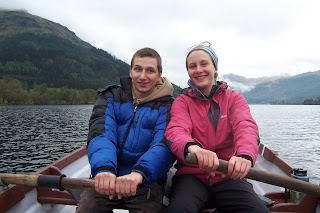
Back to time at the Coylet: I got to go out in one of the boats that the hotel hires last week, namely the powan, named for a fish in the loch (the other is our non-motor boat called the char). The trip commenced with Chris driving and Julie and I sitting about admiring the view and the rain. Then when Chris tired of driving he convinced me to do it, which was easy enough although hard on the left arm after awhile because you have to hold it almost behind your back to keep the throttle down. We cut the engine as we approached some swans and Chris and Julie rowed us in, as shown below:

Then I started the engine up again with instructions from Chris, and we motored around some more over to some sheep on the shore, and then back to the hotel. The rain had stopped after the first few minutes, at least for awhile, so I got some photos.
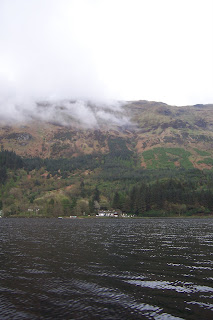
Here is the Coylet Inn and the mountain that it sits in front of. It never seemed so big when I was just living below it; the Coylet looks so small by comparison. I climbed the bit toward the right of the photo, where there's no trees to the right of the bright green bits.

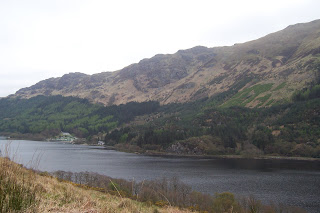
This photo I actually took when I walked part way up the hill on the other side of the loch; here you see the caravan park on the left and the Coylet to it's immediate right.

I have more photos but will get them off my camera when facilities permit.
Monday, April 23, 2007
Driving lesson and the old Coylet
I forgot to mention in my last post something rather exciting (to me at least) that I did recently: I got a lesson on how to drive a manual transmission car!
Pretty much every car in the UK, and in Europe as far as I know, is a manual, or standard as we call them in Canada, so I haven't been able to drive anything. I've been asking people I work with to teach me ever since I've been here, but of course it's tricky because I don't have my insurance and over here you're not covered insurance-wise just to drive someone else's car on a one-time basis. But a week ago Thursday, Fraser took me down to a forestry road that's at Ardentinny beach and we drove around in circles on the gravel road. My biggest problem was not letting the clutch off slow enough when I was starting from a dead stop, but I managed alright and even though the car had a loose gearbox and I would sometimes end up in fourth instead of second gear, I could definitely hear something was wrong and correct myself. So now I feel I could rent a car and then with practice driving I'd be quite fine. I haven't driven on the road, so there'd be that driving on the left-hand side to get used to (it was weird enough sitting on the right-hand side of the car) but I'm sure that difference can be over come as well.
And now for something different.
There's some old photos of the Coylet hanging on the walls here that date from late 1800's I'd guess from the clothing and modes of transportation. I've taken photos of them with my camera, so of course the images aren't great, but I thought it would be neat to try to show them at least. I find it interesting firstly that there's no trees on the hills, and also that the place basically looks the same as it does now.
Pretty much every car in the UK, and in Europe as far as I know, is a manual, or standard as we call them in Canada, so I haven't been able to drive anything. I've been asking people I work with to teach me ever since I've been here, but of course it's tricky because I don't have my insurance and over here you're not covered insurance-wise just to drive someone else's car on a one-time basis. But a week ago Thursday, Fraser took me down to a forestry road that's at Ardentinny beach and we drove around in circles on the gravel road. My biggest problem was not letting the clutch off slow enough when I was starting from a dead stop, but I managed alright and even though the car had a loose gearbox and I would sometimes end up in fourth instead of second gear, I could definitely hear something was wrong and correct myself. So now I feel I could rent a car and then with practice driving I'd be quite fine. I haven't driven on the road, so there'd be that driving on the left-hand side to get used to (it was weird enough sitting on the right-hand side of the car) but I'm sure that difference can be over come as well.
And now for something different.
There's some old photos of the Coylet hanging on the walls here that date from late 1800's I'd guess from the clothing and modes of transportation. I've taken photos of them with my camera, so of course the images aren't great, but I thought it would be neat to try to show them at least. I find it interesting firstly that there's no trees on the hills, and also that the place basically looks the same as it does now.

The road used to end at the Coylet and to go farther north you either had to go around a coastal road or take a ferry up Loch Eck to where there was a road. I don't know if this picture is of the ferry, or of ships that used to just sail up the loch from the river to the south (they used to do tours on the loch as well), but whatever this pier was roughly opposite the hotel, as I recognize the shape of the mountains in the background (again with no trees on them).

It's hard to see it here, but those wagons have about 20 to 30 people each loaded on them. Travelling in comfort.
It rarely occurs to me just how old the Coylet Inn is - it's late 17th century from what I know, which means that it's 300 to 350 years old. When the inn was built, the ancestors of most Canadians were not in Canada - in my case they were in Scotland, Ireland, and England, with the bulk of them not even speaking English at the time and probably not yet converted from Catholicism to Protestantism.
The thing is, I've spent six months living and working in a building that's older than anything in PEI, but it doesn't feel old. Sure the staircase is small and quite steep, and the roof slopes in quite a bit in the upstairs, but the place doesn't remind me every day just how old it is. I'm not really sure what it would take for me to feel that it's old.
Saturday, April 21, 2007
The post with no name
To be unoriginal, time is flying by. Karen made up our rota (work schedule) for the next upcoming two weeks a few days ago and I now have 4 days of work left at the old Coylet. I'll probably be leaving here on April 27 and travelling to Glasgow. I'll spend the weekend in the city, doing some touristy things (I really like Glasgow as far as cities go) and preparing to head off on my trip. I've got a plane ticket booked to fly to Beauvais, an airport north of Paris, on April 30, and then on May 1 I can start using my train pass and I'll be heading at first for Normandy.
I think I mentioned going to see a ceilidh last time I wrote. Well, that didn't pan out because by the time we got down to the ceilidh, at 11:30pm, we were told it was over. Having been told that they often ran well into the early hours of the morning that was somewhat of a disappointment, but we quickly formulated a plan B. The previously mentioned Jez of the kayak drove us to Sandbank (where the American naval base used to be) to a pub called the Oakbank where live music was on of the rock and roll format as opposed to Celtic. The "we" being Julie, Pickle, Matt, and I, to be later joined by Fraser, and of course Jez our driver. The only other times I have been in the Oakbank were with the staff boys to play pool and that was on weeknights. It's the kind of pub that has a very local, frequent clientele, and on one night I had been there before several people had brought their large dogs with them, and the dogs proceded to wrestle all over the pub, knocking into chairs and table occasionally. I thought that was brillant. Anyway, I have digressed. The band at the Oakbank, regulars called Electric Soup, proved to be entertaining so the evening was not lost.
The rain has returned here, although there's also been some sunny days as well. Yesterday I walked to the other side of the loch, and part way up the mountain to get a view of my home for the last six months. The hotel looks very tiny when seen against the backdrop of the mountain behind it.
Today I was planning to go to Inverary to see the castle that has been closed for the season during much of my stay here. Alas, the one bus I needed to catch was 10 minutes early and so I saw it go by as I was sitting inside finishing my tea and toast. So I've had a rather uneventful day off, but in an hour Julie and I are heading into Dunoon to go see a fiddle concert.
Work has quieted down after the Easter holidays, but we did have a wedding last Saturday that was quite fun to work. It was actually a "civil union" as I believe they're termed - two women who have a holiday caravan in the same park that I'm living in. The two ladies, and their assorted guests were all great people who were a pleasure to serve, and to top it off since we had been closed for food all day we all pretty much got off work at 8pm once the cleaning up was done, except for poor Karen who had to mind the bar.
Have to head off soon, so will leave more for later. There will definitely be some updates before I go to Europe.
I think I mentioned going to see a ceilidh last time I wrote. Well, that didn't pan out because by the time we got down to the ceilidh, at 11:30pm, we were told it was over. Having been told that they often ran well into the early hours of the morning that was somewhat of a disappointment, but we quickly formulated a plan B. The previously mentioned Jez of the kayak drove us to Sandbank (where the American naval base used to be) to a pub called the Oakbank where live music was on of the rock and roll format as opposed to Celtic. The "we" being Julie, Pickle, Matt, and I, to be later joined by Fraser, and of course Jez our driver. The only other times I have been in the Oakbank were with the staff boys to play pool and that was on weeknights. It's the kind of pub that has a very local, frequent clientele, and on one night I had been there before several people had brought their large dogs with them, and the dogs proceded to wrestle all over the pub, knocking into chairs and table occasionally. I thought that was brillant. Anyway, I have digressed. The band at the Oakbank, regulars called Electric Soup, proved to be entertaining so the evening was not lost.
The rain has returned here, although there's also been some sunny days as well. Yesterday I walked to the other side of the loch, and part way up the mountain to get a view of my home for the last six months. The hotel looks very tiny when seen against the backdrop of the mountain behind it.
Today I was planning to go to Inverary to see the castle that has been closed for the season during much of my stay here. Alas, the one bus I needed to catch was 10 minutes early and so I saw it go by as I was sitting inside finishing my tea and toast. So I've had a rather uneventful day off, but in an hour Julie and I are heading into Dunoon to go see a fiddle concert.
Work has quieted down after the Easter holidays, but we did have a wedding last Saturday that was quite fun to work. It was actually a "civil union" as I believe they're termed - two women who have a holiday caravan in the same park that I'm living in. The two ladies, and their assorted guests were all great people who were a pleasure to serve, and to top it off since we had been closed for food all day we all pretty much got off work at 8pm once the cleaning up was done, except for poor Karen who had to mind the bar.
Have to head off soon, so will leave more for later. There will definitely be some updates before I go to Europe.
Friday, April 06, 2007
A Whirlwind of Activity
I've been up to lots of fun stuff lately. Last I wrote the weather was cold - well, it's warmed up some and been quite sunny during the days so that it's been almost hot. It cools down overnight but the daytime has been fabulous. This has made for excellent opportunities for outdoor activities.
Also, since schools are on Easter Holidays here now (two weeks), business has been picking up and that meant new staff. We've got a "new" second chef - Chris, from Kirn (near Dunoon) who worked here before but then left and has just come back from British Columbia. Then we got Julie from Edinburgh about two weeks ago, and she's living in the caravan with me and Margaret who arrived from Poland a few days ago. We've been going on hikes together when we have the time, and having bonfires on the loch shore a few nights and gone out into the wild nightlife of Dunoon a few times (it's wild in an anti-social behaviour sort-of-way). I've gotten out on the loch in a kayak that a regular customer, Jez, has loaned us (very kind of him) and that was great. I also took a very brief swim in the loch because I figured I should at least get in the water once before I left here. It lasted about 20 seconds because the water is very cold (like glacial). And then there's plans for going to a ceilidh at Uig Hall down the road tomorrow night, and it's pronounced "wig", not "you-ig" as we say it in PEI.
Scotland's like any other place in the world that has a winter, in that it feels very different once the winter starts to end. It's a whole other atmosphere when the sun is out, and it's not raining. Of course there will be rain again at some point. And I'll be packing my bags in a few weeks time, as my Eurail train pass that I won commences on the first of May, so I'll be off to the continent. I'm going to miss the place, but the hope is that I'll have fun elsewhere (I'm sounding all sentimental now ;) ).
Also, since schools are on Easter Holidays here now (two weeks), business has been picking up and that meant new staff. We've got a "new" second chef - Chris, from Kirn (near Dunoon) who worked here before but then left and has just come back from British Columbia. Then we got Julie from Edinburgh about two weeks ago, and she's living in the caravan with me and Margaret who arrived from Poland a few days ago. We've been going on hikes together when we have the time, and having bonfires on the loch shore a few nights and gone out into the wild nightlife of Dunoon a few times (it's wild in an anti-social behaviour sort-of-way). I've gotten out on the loch in a kayak that a regular customer, Jez, has loaned us (very kind of him) and that was great. I also took a very brief swim in the loch because I figured I should at least get in the water once before I left here. It lasted about 20 seconds because the water is very cold (like glacial). And then there's plans for going to a ceilidh at Uig Hall down the road tomorrow night, and it's pronounced "wig", not "you-ig" as we say it in PEI.
Scotland's like any other place in the world that has a winter, in that it feels very different once the winter starts to end. It's a whole other atmosphere when the sun is out, and it's not raining. Of course there will be rain again at some point. And I'll be packing my bags in a few weeks time, as my Eurail train pass that I won commences on the first of May, so I'll be off to the continent. I'm going to miss the place, but the hope is that I'll have fun elsewhere (I'm sounding all sentimental now ;) ).
Friday, March 30, 2007
Round and round the roundabout
Just to be clear, a roundabout is what I've been taught to call a rotary, which I guess is short for rotary junction. It's when several roads meet and instead of putting up stop signs or traffic lights, the traffic is made to flow in a circle with exits to the roads at various points. In Canada, rotaries are infrequent and used only for major roads like highways (with the exception of Sherwood Park, Alberta). In Scotland, the are frequent, and in Ireland it seems to me they are even more frequent.
Let me put it this way. In Dunoon, there is a street called John Street, on which lies my bank and the supermarket. John Street forms a T-intersection with Alexandra Parade, a street that runs along the waterfront. In any Canadian town of Dunoon's size, this intersection would have a stop sign on John Street. Or perhaps given that John Street is busy enough, there would be a three-way stop at the intersection. This is not the case. Instead, there is a little concrete circle, only about 3-4 feet in diameter, in the centre of the intersection. It is a roundabout, albeit a tiny one. There is another roundabout farther down Alexandra Parade by the ferry where the street merges with Argyll Street (the main drag) to form a street called Victoria Parade. And according to my map of Dunoon, there's another roundabout farther down that street. So Dunoon has three roundabouts in a town of about 9,000 people.
Roundabouts are even more frequent out on the highways, known as motorways in this country, and to my amusement, dual carriageways when it's a divided highway. I picture horse-drawn carriages zipping along at 70 mph. Another similar out-of-date term is "telegraph pole" for any pole, be it telephone or electrical. Anyway, from what I've seen of the motorways in Scotland and Ireland, instead of using a ramp-exit system with over/under-passes like is used on Canadian highways, roundabouts are used whenever roads meet. There are sometimes over/under-passes, but they are still part of a roundabout. These large roundabouts don't have little concrete circles in the middle obviously, instead they have raised banks of grass with plants and trees.
On a bus from Dublin to Kilkenny, near the town of Naas, my bus went through three roundabouts in succession. I'm not joking - through one roundabout, then a few hundred yards of straight road before another, and then repeat. I have no idea how much the bus' direction of travel was altered from its original course after all that whirling around - we could have been going back again for all I knew.
Let me put it this way. In Dunoon, there is a street called John Street, on which lies my bank and the supermarket. John Street forms a T-intersection with Alexandra Parade, a street that runs along the waterfront. In any Canadian town of Dunoon's size, this intersection would have a stop sign on John Street. Or perhaps given that John Street is busy enough, there would be a three-way stop at the intersection. This is not the case. Instead, there is a little concrete circle, only about 3-4 feet in diameter, in the centre of the intersection. It is a roundabout, albeit a tiny one. There is another roundabout farther down Alexandra Parade by the ferry where the street merges with Argyll Street (the main drag) to form a street called Victoria Parade. And according to my map of Dunoon, there's another roundabout farther down that street. So Dunoon has three roundabouts in a town of about 9,000 people.
Roundabouts are even more frequent out on the highways, known as motorways in this country, and to my amusement, dual carriageways when it's a divided highway. I picture horse-drawn carriages zipping along at 70 mph. Another similar out-of-date term is "telegraph pole" for any pole, be it telephone or electrical. Anyway, from what I've seen of the motorways in Scotland and Ireland, instead of using a ramp-exit system with over/under-passes like is used on Canadian highways, roundabouts are used whenever roads meet. There are sometimes over/under-passes, but they are still part of a roundabout. These large roundabouts don't have little concrete circles in the middle obviously, instead they have raised banks of grass with plants and trees.
On a bus from Dublin to Kilkenny, near the town of Naas, my bus went through three roundabouts in succession. I'm not joking - through one roundabout, then a few hundred yards of straight road before another, and then repeat. I have no idea how much the bus' direction of travel was altered from its original course after all that whirling around - we could have been going back again for all I knew.
Betcha didn't know
I'm not entirely sure about all the sports betting laws in Canada, but what I do notice is different in Scotland is that you can walk into a bookies in the middle of town and bet on any number of sports. In fact, I never realized that "bookie" was short for "bookmaker" until I walked by a business labelled as such in Gourock.
There is one major chain of bookies called Ladbrokes - there's one in Dunoon, and there seems to be one every few blocks in cities like Glasgow and Edinburgh. They do not use the term "bookmakers" at all on their signs, and so when I first arrived in the country and saw these Ladbrokes all over the place I was perplexed by them. From their posters I gathered that they had something to do with money but the language was not that of banks and seemed to be aimed at men only. It wasn't until someone at work mentioned Ladbrokes, some many weeks later, that I discovered what they do and it all finally made sense.
Ladbrokes presents a very clean-cut sort of business - not the grotty, secretive image of a bookie that I've always held. An outlet in central Glasgow even had a fancy brick storefront and stained-glass windows with images of football players, race horses and other sports. Classy.
In Ireland the presence of bookies is even greater. In addition to Ladbrokes there is another chain, Paddy Power. Even the smallest of towns, consisting of a little more than on street with a few shops, would have at least one bookies.
There is one major chain of bookies called Ladbrokes - there's one in Dunoon, and there seems to be one every few blocks in cities like Glasgow and Edinburgh. They do not use the term "bookmakers" at all on their signs, and so when I first arrived in the country and saw these Ladbrokes all over the place I was perplexed by them. From their posters I gathered that they had something to do with money but the language was not that of banks and seemed to be aimed at men only. It wasn't until someone at work mentioned Ladbrokes, some many weeks later, that I discovered what they do and it all finally made sense.
Ladbrokes presents a very clean-cut sort of business - not the grotty, secretive image of a bookie that I've always held. An outlet in central Glasgow even had a fancy brick storefront and stained-glass windows with images of football players, race horses and other sports. Classy.
In Ireland the presence of bookies is even greater. In addition to Ladbrokes there is another chain, Paddy Power. Even the smallest of towns, consisting of a little more than on street with a few shops, would have at least one bookies.
Thursday, March 22, 2007
The Sporting Life
So today I thought I'd write a bit about sports - or what I shall refer to from here on as "sport" because it's never pluralized in the UK, unless you were to say something like "Football and rugby are two sports that I play".
Sport is incredibly important to people in the UK, or at least to the men. I daresay it is more important than it is to men in Canada. The sport section of most newspapers is often as big as the entire remainder of the newspaper - news, business, arts and entertainment all combined (except on Saturdays and Sundays when those sections get expanded and the newspapers go section-crazy to deliever you a phone-book sized paper).
If one judges popularity of a sport based on the number of newspaper pages devoted to it, then football (soccer - apparently that name comes from some bizarre shortening of "association football") is the most popular sport by far. I haven't revealed anything startling as most people have probably heard something about the football obsession in the UK. Even knowing that, I found the extent of the obsession surprising when I came here. There's at least half-a-dozen leagues between England and Scotland that have to be reported on, in great detail, every day in the newspapers, and these teams are somehow entwined into various European leagues in ways that I can't figure out. People say that Canadians are obsessed with hockey, but the English, Scottish, and Irish make the Canadian obsession look like a passing interest. I'm not exaggerating - you should see how much written-word is devoted to every match that is played. What's funny is that all these countries are obsessed with a sport that they're not even very good at, as World Cup results will show.
After football, rugby probably gets the second-most number of sports pages, but it's a distant second. Then, depending on the season I guess, and whether it's a Scottish newspaper or English one, there can be articles on cricket (more in English papers), tennis, hockey (field hockey), horse racing, track events. There's actually articles on snooker (pronounced snooooh-ker) and darts which I consider to be games rather than sports. In my opinion, if the participants can actually smoke and drink during the activity then it's a game, not a sport.
Then on a general results page, you'll often find brief summaries of North American pro sports game scores, including the NHL under the heading "ice hockey". I find that remarkable, as it's an obscure sport over here and it's not like I've ever seen anything in a Canadian newspaper about a Scottish sport like shinty (something like violent field hockey).
Sport is incredibly important to people in the UK, or at least to the men. I daresay it is more important than it is to men in Canada. The sport section of most newspapers is often as big as the entire remainder of the newspaper - news, business, arts and entertainment all combined (except on Saturdays and Sundays when those sections get expanded and the newspapers go section-crazy to deliever you a phone-book sized paper).
If one judges popularity of a sport based on the number of newspaper pages devoted to it, then football (soccer - apparently that name comes from some bizarre shortening of "association football") is the most popular sport by far. I haven't revealed anything startling as most people have probably heard something about the football obsession in the UK. Even knowing that, I found the extent of the obsession surprising when I came here. There's at least half-a-dozen leagues between England and Scotland that have to be reported on, in great detail, every day in the newspapers, and these teams are somehow entwined into various European leagues in ways that I can't figure out. People say that Canadians are obsessed with hockey, but the English, Scottish, and Irish make the Canadian obsession look like a passing interest. I'm not exaggerating - you should see how much written-word is devoted to every match that is played. What's funny is that all these countries are obsessed with a sport that they're not even very good at, as World Cup results will show.
After football, rugby probably gets the second-most number of sports pages, but it's a distant second. Then, depending on the season I guess, and whether it's a Scottish newspaper or English one, there can be articles on cricket (more in English papers), tennis, hockey (field hockey), horse racing, track events. There's actually articles on snooker (pronounced snooooh-ker) and darts which I consider to be games rather than sports. In my opinion, if the participants can actually smoke and drink during the activity then it's a game, not a sport.
Then on a general results page, you'll often find brief summaries of North American pro sports game scores, including the NHL under the heading "ice hockey". I find that remarkable, as it's an obscure sport over here and it's not like I've ever seen anything in a Canadian newspaper about a Scottish sport like shinty (something like violent field hockey).
Wednesday, March 21, 2007
Newspapers and Toilets
It seems to me that there is a plethora of choice in newspapers in this country. Ones from Glasgow, Edinburgh, London, other English cities, "national" newspapers, and then the little local ones. Perhaps this is the result of several nations being united as one, the United Kingdom. Maybe it's a result of there being 60 million people in the UK compared to Canada's 30 million. But then there's only 5 million people in Scotland and it has two newspapers claiming to be national ones - Edinburgh's The Scotsman and Glasgow's The Herald. Canada only has two newspapers that claim to be national - The Globe and Mail and The National Post - and they're both out of the same city.
Given that there are so many newspapers in Scotland, I'm inclined to believe that Scots (and you can extend this to the English as well) simply buy more newspapers than Canadians. That's not to say that Scots are more interested in the news, as there is, in addition to the "broadsheet" newspapers, an astonishing number of what I would term "trashy" newspapers. These papers boldly proclaim that they cost only 10 to 15p (broadsheets cost from 65p to £1). The "trashy" newspapers pretty much focus on a few news headlines done sensationally (murders are a favourite topic), then there's celebrity gossip and sport.
These papers also inevitibly have a page 3 girl, like any newspaper called The Sun in Canada does (and many are called Sun over here as well). The difference is that the page 3 girls over here are photographed topless, a sight that astonished my innocent Islander eyes when I first flipped through a copy of The Scottish Sun. I expected that from certain magazines, but not from anything claiming to be news that you could just buy at the supermarket. The Scottish Sun even ran a competition with a spread of topless photos of contestants for page 3. To my amusement, next to each girl's topless photo they printed a smaller photo of her wearing a bikini top, which seemed rather pointless in an after-the-fact sort of way. Then there's the Scottish Sport, a paper that doesn't limit itself to page 3 for toplessness. It also presents little sport news, and much more of the topless news.
The UK often gets a reputation for being a bit old-fashioned and stiff, but their newspapers make Canada look prudish. Another way that Canadians seem prudish compared to Scots is that we always ask where the "washroom" or "bathroom" is, instead of the "toilets" as is done over here. Signs are labelled with "toilets" on them, or just the singular form. You say "I'm going to the toilet" even in polite conversation, whereas I was trained from the time I was a child to say "I'm going to the bathroom" and it seems a little inproper to me to say the former.
I remember learning how to ask that in French class. All us nine-year-old kids were a bit taken aback at asking to go to the toilet as it seemed too direct on such a taboo subject. Canadians, I think, don't like to say that we're going to the toilet because that tells everyone exactly what we're going to do: use the toilet. By saying that we're going to the "bathroom" (even when there's no bath in it) we can pretend that we're going to do something else other than use the toilet, even though all parties involved in the conversation know otherwise. Scots, on the other hand, have no problem admitting that they're going to use the toilet.
Given that there are so many newspapers in Scotland, I'm inclined to believe that Scots (and you can extend this to the English as well) simply buy more newspapers than Canadians. That's not to say that Scots are more interested in the news, as there is, in addition to the "broadsheet" newspapers, an astonishing number of what I would term "trashy" newspapers. These papers boldly proclaim that they cost only 10 to 15p (broadsheets cost from 65p to £1). The "trashy" newspapers pretty much focus on a few news headlines done sensationally (murders are a favourite topic), then there's celebrity gossip and sport.
These papers also inevitibly have a page 3 girl, like any newspaper called The Sun in Canada does (and many are called Sun over here as well). The difference is that the page 3 girls over here are photographed topless, a sight that astonished my innocent Islander eyes when I first flipped through a copy of The Scottish Sun. I expected that from certain magazines, but not from anything claiming to be news that you could just buy at the supermarket. The Scottish Sun even ran a competition with a spread of topless photos of contestants for page 3. To my amusement, next to each girl's topless photo they printed a smaller photo of her wearing a bikini top, which seemed rather pointless in an after-the-fact sort of way. Then there's the Scottish Sport, a paper that doesn't limit itself to page 3 for toplessness. It also presents little sport news, and much more of the topless news.
The UK often gets a reputation for being a bit old-fashioned and stiff, but their newspapers make Canada look prudish. Another way that Canadians seem prudish compared to Scots is that we always ask where the "washroom" or "bathroom" is, instead of the "toilets" as is done over here. Signs are labelled with "toilets" on them, or just the singular form. You say "I'm going to the toilet" even in polite conversation, whereas I was trained from the time I was a child to say "I'm going to the bathroom" and it seems a little inproper to me to say the former.
I remember learning how to ask that in French class. All us nine-year-old kids were a bit taken aback at asking to go to the toilet as it seemed too direct on such a taboo subject. Canadians, I think, don't like to say that we're going to the toilet because that tells everyone exactly what we're going to do: use the toilet. By saying that we're going to the "bathroom" (even when there's no bath in it) we can pretend that we're going to do something else other than use the toilet, even though all parties involved in the conversation know otherwise. Scots, on the other hand, have no problem admitting that they're going to use the toilet.
Tuesday, March 20, 2007
Trailer Park Girl in The Return of Winter
Since a week-and-a-half ago I've been living in the hotel's caravan at the park just up the road, a caravan being a mobile home. The park is a holiday park so there's not really anyone else staying there in the other caravans other than on weekends. The reason for my move is that we have a new 2nd chef, Chris, who's worked at the Coylet more than a year ago, and he took Matt's room and Matt took my room. At the moment I have the caravan to myself, but by next weekend we have a new girl starting who'll be living with me, and then at the start of April there will be another girl. The school Easter holidays are in April this year and for about two weeks, so tourism picks up at that time and we need more workers.
In other news, it had seemed that winter had passed by here as there's daffodils popping up everywhere and buds on the trees. Then this weekend there was hailstorms, and snow on the hilltops. It's been chilly yesterday and today - above freezing since I can't see my breath but still cold enough feeling.
In other news, it had seemed that winter had passed by here as there's daffodils popping up everywhere and buds on the trees. Then this weekend there was hailstorms, and snow on the hilltops. It's been chilly yesterday and today - above freezing since I can't see my breath but still cold enough feeling.
Thursday, March 01, 2007


Subscribe to:
Posts (Atom)