I'm down at Loch Ness again this weekend, though perhaps the last one for a while as someone else is coming down from Inverness next weekend to be the relief. Anyway, it's not a bad wee hostel and good for a change.
Didn't go anywhere on my days off this week, as with being up and down between hostels I felt I could use some time staying in one place. Just took it easy reading a book, doing some cooking, went out with a fella a couple of times, and caught up on sleep.
I think I met some of the "we're not Canadian" Quebecker types the other day. I heard them speaking in French, and asked them in French if they were French, to which they replied "Non, Quebecois". To that I replied "Oh, je suis canadienne aussi!" to be met by silence. One of them later said "Ontario?" to me, but that was about it.
On the other hand, a woman who was actually from France mistook me for French when I informed her about how to get to the kitchen, since I could hear her mumbling to herself in French, wondering where it was.
Saturday, March 29, 2008


Friday, March 28, 2008
New posts
Posts on Skye trip are up. Sorry some of them are kind of choppy; I've been writing them on rushed time. Might get to edit them up a bit later. There's photos (more than what's in the post) in the usual spot on my web albums.
Sunday, March 23, 2008
The roundabouts are coming?
Just looking through the PEI news, and I've seen two suggestions that there should be roundabouts on the Island (when they started being called that back home, I don't know, I've always heard them called rotaries).
There's a letter to the editor in The Guardian suggesting that a roundabout could have made a recent fatal accident much less serious if not avoided it at all, because people are forced to slow down for roundabouts.
Then there's a comment added to an article in The Guardian about some hour-of-darkness-for-the-environment scheme that Charlottetown's going to do. The comment suggests that to help avoid energy waste we should replace intersections with traffic lights with roundabouts because then cars aren't idling creating pollution and lights aren't running consuming energy.
Besides the fact that I think Island drivers are going to have a hard time dealing with roundabouts as they can't merge and the like (I remember the two-lane Hillsborough Bridge, and I remember all the fuss in the news when two side-by-side left turning lanes were installed at the Southport bridge intersection), my problem with roundabouts is that they slow traffic down. You're motoring along on the highway, and then because there's a road junction everyone has to slow down, not just the people who want to leave the highway.
I heard tell on a visit home of a rotary up Summerside way; I believe it was proving to be a little difficult for big trucks to negotiate. I've never driven through it, so I've never driven through a rotary on the Island. I don't really expect to be finding them there any time soon.
There's a letter to the editor in The Guardian suggesting that a roundabout could have made a recent fatal accident much less serious if not avoided it at all, because people are forced to slow down for roundabouts.
Then there's a comment added to an article in The Guardian about some hour-of-darkness-for-the-environment scheme that Charlottetown's going to do. The comment suggests that to help avoid energy waste we should replace intersections with traffic lights with roundabouts because then cars aren't idling creating pollution and lights aren't running consuming energy.
Besides the fact that I think Island drivers are going to have a hard time dealing with roundabouts as they can't merge and the like (I remember the two-lane Hillsborough Bridge, and I remember all the fuss in the news when two side-by-side left turning lanes were installed at the Southport bridge intersection), my problem with roundabouts is that they slow traffic down. You're motoring along on the highway, and then because there's a road junction everyone has to slow down, not just the people who want to leave the highway.
I heard tell on a visit home of a rotary up Summerside way; I believe it was proving to be a little difficult for big trucks to negotiate. I've never driven through it, so I've never driven through a rotary on the Island. I don't really expect to be finding them there any time soon.
Saturday, March 22, 2008
There will be posts
Well, I'm at the Loch Ness hostel tonight, working reception and reading through the Inverness Press and Journal while I wait for arrivals and turn away people who haven't booked (most places are full this weekend). The north of Scotland may have more people than PEI, but that doesn't stop its newspaper from having characteristic small-town/rural stories. Like the news brief about how the shops were busy yesterday as people prepared for the Easter holiday, and that some readers reported not being able to find parking spaces at the Morrisons supermarket. I just love those sorts of stories.
On the more bizarre side is the article entitled "White witch curses latest Nessie hunt". Unfortunately, the online version doesn't have the picture of the witch, a long-yellow-haired fellow in a burgundy bath robe on the loch shore.
There was snow overnight in Inverness, and some small hailstones fell here at Alltsigh briefly while I was carrying a mop bucket from one building to the other. The forecast called for "wintry showers" today (I think we'd call that "flurries" at home) and predicts heavy snow overnight.
The point of this post was to tell you that there will be some more posts soon. I spent last weekend here at Loch Ness, then went back to Inverness to work for three days there. Then I hired a car Wednesday afternoon, drove to Loch Ness to visit Tina overnight, then drove to Skye on Thursday morning and ran the roads around there that day and Friday morning, staying in Broadford overnight. I returned the hire car Friday afternoon, spent a night in my own bed, then it was down here again this morning to relieve Tina. So I've pictures to upload and tales to tell, but what with the Easter holiday and my jet-setting lifestyle, I've not gotten to the library to put up pictures. I might get some up tomorrow if Tina lets me use her laptop. Anyway, when I do post I will probably archive post them to the day I'm writing about, but I'll let you know.
On the more bizarre side is the article entitled "White witch curses latest Nessie hunt". Unfortunately, the online version doesn't have the picture of the witch, a long-yellow-haired fellow in a burgundy bath robe on the loch shore.
There was snow overnight in Inverness, and some small hailstones fell here at Alltsigh briefly while I was carrying a mop bucket from one building to the other. The forecast called for "wintry showers" today (I think we'd call that "flurries" at home) and predicts heavy snow overnight.
The point of this post was to tell you that there will be some more posts soon. I spent last weekend here at Loch Ness, then went back to Inverness to work for three days there. Then I hired a car Wednesday afternoon, drove to Loch Ness to visit Tina overnight, then drove to Skye on Thursday morning and ran the roads around there that day and Friday morning, staying in Broadford overnight. I returned the hire car Friday afternoon, spent a night in my own bed, then it was down here again this morning to relieve Tina. So I've pictures to upload and tales to tell, but what with the Easter holiday and my jet-setting lifestyle, I've not gotten to the library to put up pictures. I might get some up tomorrow if Tina lets me use her laptop. Anyway, when I do post I will probably archive post them to the day I'm writing about, but I'll let you know.
Friday, March 21, 2008
Skye Trip Day Three
Here's a map of the day's travels.
So, due to my camera batteries dying and having forgotten to bring my spares, the only photos I have from the second day of travelling on Skye are on my phone, and at the moment I can't get those off it on to a computer. So the internet will have to provide photos, hopefully from people with better cameras than I who visited the places on the better-weather days!
I left Broadford in the morning, and on the drive up the island I saw on the Cuillin that there had been snow on the tops overnight, and also that there was no cloud covering the very top for the first time that I recall.
On the drive, I noticed some sheep warning signs, which I'm pretty sure were not on that road last summer. They looked pretty shiny-new red and white, so I'm wondering if they are a new initiative. Again, they were on a road where there isn't really the risk of sheep running on to it, because it's a busy road so people keep their sheep fenced off of it.
I passed through Portree and then up the east coast of the Trotternish peninsula, on a road that I haven't been down since I cycled it almost 6 years ago on my first visit to Skye. I passed the Old Man of Storr, but didn't stop to walk up to it as I did that walk on the aforementioned cycling trip.
I did stop quickly to see Kilt Rock, since it involved just standing in the car park to look at it. It was so windy at that time that a nearby waterfall was blowing upward in gusts and I dashed around it several times to the amusement of a couple who were staying inside their car.Then at Staffin, I took the road to the Quiraing, and got out of the car to do a walk on a side more sheltered from the wind. It's an amazing location; the landscape is a bit weird and surreal.
I followed that road along to Uig and nipped up to the Faery Glen for a short walk and to eat my lunch.
After that I did the return trip, although I did alter my route to go along the single track road on the south side of Loch Ness for a change of scenery.
Thursday, March 20, 2008
Skye Trip Day Two
Here's a map of my trip this day.
I had stopped overnight at Loch Ness with Tina, and I left the hostel at about 9am in the morning. I drove down to Invernmoriston where I took the road toward Kyle of Lochalsh. It first passed by Loch Cluanie, which is held back on one end by a big dam.
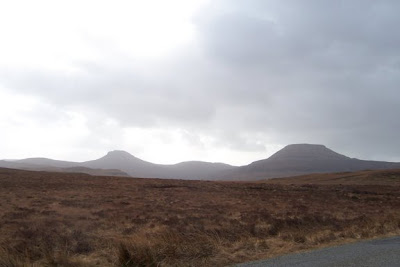
The road then passes through Glen Shiel. It's absolutely stunning, though pictures don't convey it so well due to the mistiness. It was hard to keep my eyes on the road!


I had stopped overnight at Loch Ness with Tina, and I left the hostel at about 9am in the morning. I drove down to Invernmoriston where I took the road toward Kyle of Lochalsh. It first passed by Loch Cluanie, which is held back on one end by a big dam.
The road then passes through Glen Shiel. It's absolutely stunning, though pictures don't convey it so well due to the mistiness. It was hard to keep my eyes on the road!


Once on to Skye, stopped in Kyleakin when the weather was back to absolutlely miserable. Had a look at the old closed up hostel, popped into the shop for a snack and then drove on up the island.
Passing through Broadford got stopped by roadworks. Had a convoy van to lead you through, something I've not seen before. I sang/hummed "Convoy" to myself whilst waiting for the cars ahead of me to move.
Drove down single track road to Elgol to get a nice view of the Cuillin. Single track roads are my kind of driving; you have to be courteous or you will run into someone. One car has to pull into a passing place to allow another to go by. It's just the logistics of the situation. And then you give a little wave to each other when you pass. There are the mad folks who want to drive super fast and try to run you off the road, that happens even on the main roads (there seems to be more of those people over here than in Canada), but they're fortunately not the majority.
I might have gone for a walk on the beach at Elgol another day, but the wind was so strong I had trouble standing in one place just to take photos without being blown off balance.
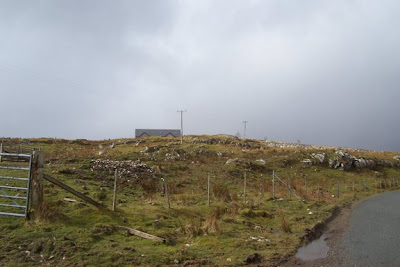

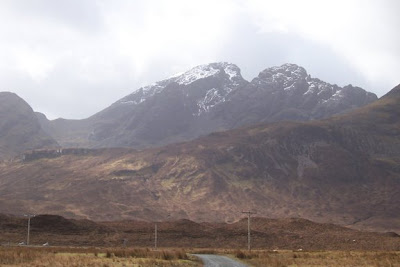
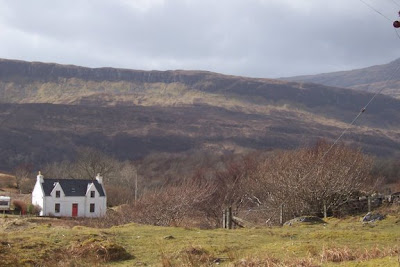
After coming back up from Elgol, I drove up the west of Skye toward Dunvegan.
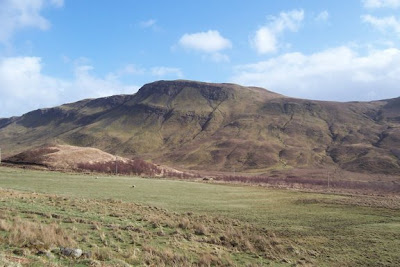
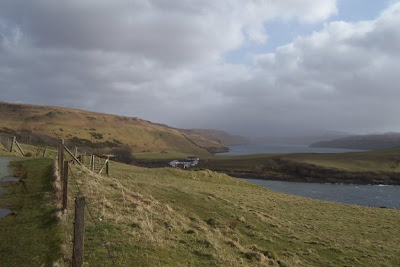


After coming back up from Elgol, I drove up the west of Skye toward Dunvegan.
Wednesday, March 19, 2008
Skye Trip Day One: Hitting the road
I picked up the hire car after finishing work. I booked an automatic because I figured it would be good to take things step-by-step and get used to driving on the opposite side before having to get used to a manual transmission. I booked the smallest car possible (i.e. the cheapest) but was told when I picked it up that I was being given a larger car due to availability. They gave me a Peugot 407, about an average-size car to me, similar in size to Chevy's like the Corsica and the Malibu or the Pontiac GrandAm (I'm just naming cars I've driven around that size).
Driving on the wrong side of the road isn't the biggest problem for me, it's sitting on the wrong side of the car. I've realized that when it comes to driving, I've developped my spatial sense on my right side, because that's where the rest of the car always have been, and on my left side I've not had to develop the distance judging quite so well. It probably doesn't help that my right eye is my better one. Anyway, it's made me paranoid about the whereabouts of the left-hand side of the car.
Had some moments of confusion involving roundabouts in Inverness itself (I've mentioned the preponderance of roundabouts over here as compared to Canada before). Stopped at the supermarket and discovered the parking spaces are smaller; what is a small-medium sized car in Canada is on the larger size here. I can't imagine how the people with pick-up trucks over here park them. The car park spaces are also designated by a complete rectangle, there isn't one open side.
Then when getting out on the A82 heading down along Loch Ness, it was getting used to the narrowness of roads and the twistiness.
The key for the car is really cool; it folds away into the plastic bit, and there's a button that caused is to swing open again. It's immensely fun to play with as you carry the keys about.
Driving on the wrong side of the road isn't the biggest problem for me, it's sitting on the wrong side of the car. I've realized that when it comes to driving, I've developped my spatial sense on my right side, because that's where the rest of the car always have been, and on my left side I've not had to develop the distance judging quite so well. It probably doesn't help that my right eye is my better one. Anyway, it's made me paranoid about the whereabouts of the left-hand side of the car.
Had some moments of confusion involving roundabouts in Inverness itself (I've mentioned the preponderance of roundabouts over here as compared to Canada before). Stopped at the supermarket and discovered the parking spaces are smaller; what is a small-medium sized car in Canada is on the larger size here. I can't imagine how the people with pick-up trucks over here park them. The car park spaces are also designated by a complete rectangle, there isn't one open side.
Then when getting out on the A82 heading down along Loch Ness, it was getting used to the narrowness of roads and the twistiness.
The key for the car is really cool; it folds away into the plastic bit, and there's a button that caused is to swing open again. It's immensely fun to play with as you carry the keys about.
Monday, March 10, 2008
Sheep can eat pickles and die
 This sign is posted along the road along Loch Ness's northern shore. Oddly enough, for the two miles after this sign, I saw no sheep, whereas I've seen them on every other rural walk I've ever taken in this country. I'm not sure where the sheep are meant to be - the loch is on one side of the road, and a forrested mountain is on the other side. There is a sign indicating falling rocks for 2 miles as well. I think the sheep must be at the top of the mountains, throwing the rocks.
The post title is a quote from Alysha. She likes neither sheep nor pickles and so combined them into one expression.
Friday, March 07, 2008
At Loch Ness Hostel
On Thursday, my hostel group was out for the day, so I headed out for a walk myself. I walked from Alltsigh (where the hostel is) southwest-ward, along the roadside, hoping to find a path up to the Great Glen Way footpath so that I wouldn't have to walk on the road. I didn't find one before arriving at Invermoriston (about 3 miles down the road), the village in Glen Moriston at the junction of the road from Inverness, the road to Fort William, and the road to Kyle of Lochalsh. The village consists of a shop/post office, a hotel with restaurant/bar, a craft shop (that didn't appear to be open yet), a coffee shop/tea room (opening in a week), a village hall, a school, and some houses.
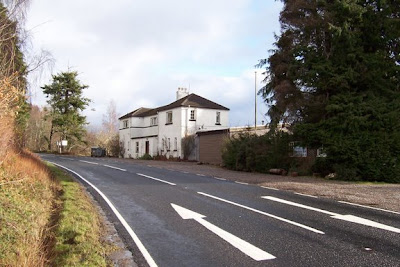
Ok, so I'm getting server errors from Google when I try to upload today (from two seperate computers), so for the photos I was going to put up and more, please see my web album. It's disorganized at the moment, and shows my fascination with trees growing in unusual ways, but I'll fix it up and label it sometime soon. And add to this post with photos.
I bought some chocolate at the shop to supplement my packed lunch, then walked in the direction of the waterfall. Along the way I stopped at Columba's Well, as it was marked - it's a not-so-spring-like (i.e. some still water surrounded by a hole in rock) spring that legend says was poisonous until St. Columba made a stop there in the late 500's and blessed it, giving the water curing properties. I guess if you're a Columba fan then it would be a highlight.
The waterfall was actually pretty neat - no Niagra, but quite fast moving water none-the-less. The bank above the river was high and dropped off sharply.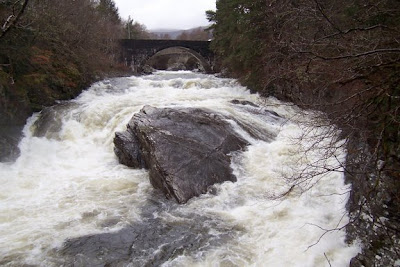
To go back to the hostel, I joined the Great Glen Way where it came out in Invermoriston. It took a seemly circuituitous route up a hill, but did provide a good view point before heading back down the hill, nearer to the road. I walked along, drinking an Irn-Bru to give me the strength to get up the hill (I'd lost my water bottle from my backpack when I'd take a bit of a fall into a hole along the riverbank), then had my lunch on the hill-top with my back turned to the rain blown by the wind. Later on, the sun broke through the clouds as the rain stopped.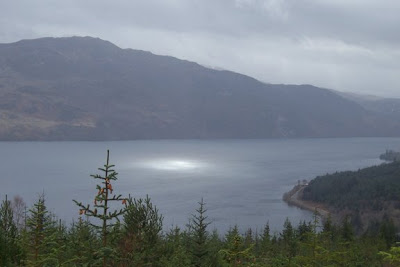
I found a path down about a mile from the hostel (it had appeared to be a gated driveway from the road), and a map indicates there must be one closer to the hostel, so I shall endeavour to find that one next time (I think I'm back here in a week to cover another Rent-a-Hostel).
Finally, here's a few photos of the Loch Ness Hostel. It's a bit old, but it's got a great location right on the lochside.
Ok, so I'm getting server errors from Google when I try to upload today (from two seperate computers), so for the photos I was going to put up and more, please see my web album. It's disorganized at the moment, and shows my fascination with trees growing in unusual ways, but I'll fix it up and label it sometime soon. And add to this post with photos.
Monday, March 03, 2008
Heading to the Loch sans locks
That post title is terrible, really.
I'm going down to the Loch Ness hostel this week to cover a "Rent-a-Hostel". This is where a group pays to have an out-of-season hostel all to themselves. It's a few hundred pounds for the entire place, so if you have a group that will fill it (in the case of Loch Ness, about 38 beds), then it's a good deal.
Anyway, tomorrow several of us from the Inverness hostel are going down to tidy up the place, then I'll be going down again Wednesday and staying there overnight and Thursday night, coming back on Friday after cleaning the place up. So that'll be another hostel under my belt.
Not too much else new with me, other than I got my haircut. I had it lopped off to what you'd call a bob cut, I guess - not quite shoulder length and layered. I'm happy with it; it's made a nice change from the ol' long hair.
I'm going down to the Loch Ness hostel this week to cover a "Rent-a-Hostel". This is where a group pays to have an out-of-season hostel all to themselves. It's a few hundred pounds for the entire place, so if you have a group that will fill it (in the case of Loch Ness, about 38 beds), then it's a good deal.
Anyway, tomorrow several of us from the Inverness hostel are going down to tidy up the place, then I'll be going down again Wednesday and staying there overnight and Thursday night, coming back on Friday after cleaning the place up. So that'll be another hostel under my belt.
Not too much else new with me, other than I got my haircut. I had it lopped off to what you'd call a bob cut, I guess - not quite shoulder length and layered. I'm happy with it; it's made a nice change from the ol' long hair.
Tuesday, February 26, 2008
Quiz comedy
A type of show that exists in the UK but not in Canada is what I've heard called "quiz comedies" (or "quizcoms" as one channel, Dave, has abbreviated it as). Essentially, these quiz shows are as much quiz shows as Who's Line Is It Anyway? was a game show - they follow vaguely the format by having contestants who answer questions, but the focus is really on comedy and not on the contest (as Drew Carey put it in the American-version of Who's Line Is It Anyway?, "the points don't matter"). In fact, some of the quiz comedies were created by Dan Patterson, the same guy responsible for Who's Line.
Why I mention this is that many of these shows are quite funny, becoming some of my favourite shows over here.
The shows that I'll describe below are orignally produced by BBC and Channel Four, but I've been watching them in re-runs on the afore-mentioned channel Dave ("the home of witty banter" according to their slogan), which was running them every week night all in one go. There's video clips at the websites of most of these shows, so you can check them out if you so wish (and since writing about comedy is sort of fruitless and impossible, I really suggest the clips over my descriptions).
QI (Quite Interesting) is a quiz show hosted by Stephen Fry that has 4 contestants, generally comedic personalities. Alan Davis seems to be on it perpetually as as contestant, generally losing. The questions are quite difficult and obscure, so giving a wrong but interesting answer is encouraged, or just discussing the question. Points are deducted for giving incorrect answers that are commonly believed to be true (for example, answering that "Ring Around the Rosie" is about the Black Death was one of them). It basically ends up being a reasonably intelligent conversation peppered by jokes, so it's quite enjoyable (and unusual for television).
Have I Got News For You has a celebrity host who cracks jokes about the news of the week, and quizzes two teams on the news. The captain of each team is constant from week-to-week (being Ian Hislop and Paul Merton) and is joined by a celebrity guest, generally a comedian. Like QI, questions result in panelists satarizing the news.
Mock The Week is sort of a spin-off from Have I Got News For You, but is more improvisational political sketch comedy than quiz show. The host is Dara O Briain (that's Irish, being pronounced something like "dahra oh-bree-an"), and there's 3-4 regulars and comedian guests to add up to two teams of three each. A few of the sketches aren't hilariously funny, but the banter between regulars and the rapid-fire segments makes up for it. I particularly enjoy the aforementioned host O Briain, Frankie Boyle, and Hugh Dennis.Never Mind The Buzzcocks (doesn't seem to have its own page so that's the Wikipedia one) is a quiz about the music industry, with varying hosts over the years and two regular team captains, Phil Jupitus and Bill Bailey, who each have two music-industry guests on their teams. There are quiz rounds that involve music itself, like finishing-off lyrics and guessing songs based on versions performed by team members, but some of the questions are almost designed as ways to make fun of pop musicians, like asking what strange items stars demand to have backstage, or who flew his hat first-class across Europe to a charity concert. Bascially, they just mock pop music.
Watching these shows has introduced me to many new comedians and allowed me to see more of comedians I'd only caught snippets of back in Canada. The two news-oriented programs have also had the benefit of teaching me about the politics and recent history of the UK. I first learned about politics by listening to the Royal Canadian Air Farce on the radio with Dad when I was a kid, and I've learned much about US politics from watching The Daily Show with Jon Stewart and The Colbert Report, so I've just carried on that method over here. It's more fun learning that way.
I'm branching out in my comedy viewings now, having started watching Chewin' The Fat, a Glaswegian sketch comedy, on DVD and so far it's very funny. The DVD actually comes with subtitles as an option for those who can't understand the patter, but so far I'm getting on right enough without them.
Monday, February 25, 2008
"Chips, glorious chips!"
McCain Food, the New Brunswick company that sells frozen fries and the like, also sells food in the UK, which I never imagined that they did. Although looking them up online, I discover that they're a very large company.
Anyway, over here their fries are known as McCain chips, and they have an elaborate song composed for their advertisement in which people who appear as though they're in a stage musical sing about sunflower oil making the chips have only 5% fat. It's quite catchy in its own way. I found a video version of it online here; there's probably others out there as well, like on YouTube.
And just because it's on the same website, here's the Christmas Irn-Bru advert that parodies a UK-well-known song called "Walking in the Air" from a Christmas special show called "The Snowman" (based on a book). Even not knowing the original song I like the ad. It's serene and amusing at once, and I have often had it stuck in my head, especially the final line of "He nicked my Irn-Bru and let go of my hand."
If you watch the video, you can see the boy and the snowman fly by famous Scottish places: the Falkirk Wheel, some sheep, the Forth Bridge, Edinburgh Princes Street Gardens (ice rink and can see the castle briefly), Loch Ness (with monster), deer, the Glenfinnan Viaduct (now famous from the Harry Potter films), Eilean Donan Castle, the Glasgow Royal Concert Hall, and then the boy falls into Glasgow's George Square. It's a pretty animation; I'd like to see the original sometime.
Anyway, over here their fries are known as McCain chips, and they have an elaborate song composed for their advertisement in which people who appear as though they're in a stage musical sing about sunflower oil making the chips have only 5% fat. It's quite catchy in its own way. I found a video version of it online here; there's probably others out there as well, like on YouTube.
And just because it's on the same website, here's the Christmas Irn-Bru advert that parodies a UK-well-known song called "Walking in the Air" from a Christmas special show called "The Snowman" (based on a book). Even not knowing the original song I like the ad. It's serene and amusing at once, and I have often had it stuck in my head, especially the final line of "He nicked my Irn-Bru and let go of my hand."
If you watch the video, you can see the boy and the snowman fly by famous Scottish places: the Falkirk Wheel, some sheep, the Forth Bridge, Edinburgh Princes Street Gardens (ice rink and can see the castle briefly), Loch Ness (with monster), deer, the Glenfinnan Viaduct (now famous from the Harry Potter films), Eilean Donan Castle, the Glasgow Royal Concert Hall, and then the boy falls into Glasgow's George Square. It's a pretty animation; I'd like to see the original sometime.
Thursday, February 21, 2008
Out to Loch Ness/Rights of way
This is Urquhart Castle, on Loch Ness. I went out on the bus to the castle on Tuesday, a day off, figuring that since hostel guests are always asking me about Loch Ness, I should finally see it for myself (that I can recall - I saw it in 2002 briefly).
Just because I discovered Google Maps the other week, I'm including a link to the map I made of my little trip, just to test it out. I always like to have a map to look at anyway when someone's talking about places, so perhaps you do as well (check out the terrain and satellite modes as well for a better view of the area). I've tried putting the HTML for the map into this post so that you can see it and click on it, but it has crashed this browser several times already.
It was a nice sunny day, as you can see from the photo, so it made for a good day to walk about. I strolled around the ruined castle at its excellent vantage point on a head of land that allows one to see both ways down the loch. The modern visitor centre is nicely hidden in the bank of the hill between the castle and the road, so it doesn't spoil one's attempts to imagine the castle as it was.
I later walked down the road to the village of Drumnadrochit, in the valley known as Glen Urquhart (the lands of which the castle protected and where all the cattle that the MacDonalds stole away back to the isles at one point were presumably pasturing). I spent a few hours wandering around in the woods and then into the farmland before catching the bus back to Inverness.
I went out on the bus to the castle on Tuesday, a day off, figuring that since hostel guests are always asking me about Loch Ness, I should finally see it for myself (that I can recall - I saw it in 2002 briefly).Just because I discovered Google Maps the other week, I'm including a link to the map I made of my little trip, just to test it out. I always like to have a map to look at anyway when someone's talking about places, so perhaps you do as well (check out the terrain and satellite modes as well for a better view of the area). I've tried putting the HTML for the map into this post so that you can see it and click on it, but it has crashed this browser several times already.
It was a nice sunny day, as you can see from the photo, so it made for a good day to walk about. I strolled around the ruined castle at its excellent vantage point on a head of land that allows one to see both ways down the loch. The modern visitor centre is nicely hidden in the bank of the hill between the castle and the road, so it doesn't spoil one's attempts to imagine the castle as it was.
I later walked down the road to the village of Drumnadrochit, in the valley known as Glen Urquhart (the lands of which the castle protected and where all the cattle that the MacDonalds stole away back to the isles at one point were presumably pasturing). I spent a few hours wandering around in the woods and then into the farmland before catching the bus back to Inverness.

On Monday, I walked over the Kessock Bridge to North Kessock where I climbed up Ord Hill which is on Forestry Commission land. It was a hazy day so the light wasn't great for photos, but here's one of Inverness and surroundings as viewed from the north (the hill in the middle is Craig Phadraig that I climbed before).

The public rights of way around this country are neat. There's old paths and stairways between streets, paths through fields and woods and up hills. In Inverness, because it's hilly, there are stairs in the town centre to take you between streets, allowing you to save time on foot as compared to following the car routes. There's also paths between houses that are public as well. When I first lived anywhere "urban" it was in Kyleakin, and I wasn't used to all the idea of between garden paths (garden = yard). I saw the paths, but with my Canadian land mindset I figured I would be walking on to someone's lawn. It wasn't until I was walking through the village with a village resident who took some of those paths as shortcuts that I realized it was alright. Since most houses have gardens that are enclosed by low walls, hedges, or fences, with gates to enter them, if a path is between those walls and isn't gated then it's ok to walk down as far as I can tell.
The paths in the "wild" so to speak, are often accessed via kissing gates, so that is how I generally figure out that it's a public path if there's no sign (since I don't tend to plan where I go well enough to have a map). I found one of the paths near Drumnadrochit because someone had kindly put up a big red sign that said "Public Footpath" and a stile (stairs, basically) over the roadside wall to what I would have assumed to be just a farm lane. I wouldn't have walked down it otherwise, and when I did I found some forest trails.
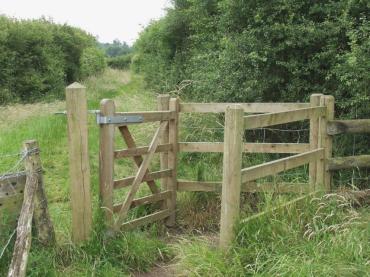
In Scotland, you basically have the right to access most land in the countryside for recreational purposes if you're reponsible according to the Scottish Outdoor Access Code. As it was first put to me, there's no such thing as tresspassing. So there's doesn't need to be a public footpath for you to go walking on land (whereas in England they have the public rights of way and then there's other land). I still stick to paths if I'm near houses, just because I'm uncomfortable walking through what might be the farm of someone I don't know. I tend to follow the rule I always used at home: if they cut the grass, I don't walk on it because it's a lawn.
Tuesday, February 19, 2008
Transport and diversions from that
So a few word differences relating to roads today. Firstly, the title, "transport". I rarely hear the word "transportation" used, it's always transport - Ministry of Transport, transport issues, etc.
Walking through the town centre the other day (not the "downtown" as I would call it), I saw a road sign saying "Diversion". In Canada, the sign would read "Detour". I find the Diversion signs amusing still; to me it's like the road works people don't want you to notice that they've closed some streets, saying "Look! Over there!" Either that, or if you follow the diversion you'll end up having a pleasant day occupied by doing things that you hadn't intended to do at the start.
Another sign I saw on my walk: "Humps". Those are speed bumps.
Yield signs look the same, but have "Give way" written on them.
The curb on the side of the road is written "kerb". The "pavement" is the sidewalk, sometimes referred to as the path. What I would call pavement, i.e. the surface that the road is made up of, I've generally heard called tarmac.
When I was in Argyll, pretty much all the guys would refer to their cars as their "motors" (and said with the accent of the region where the "t" is barely said in the back of the throat (a glottal stop?), it comes out like "mo-er"). It then seems logical that the highways are always referred to as "motorways".
If you have a motorway that is divided, i.e. some barrier between opposing directions of traffic, then it becomes a "dual carriageway". The carriage bit seems to me to be old-fashioned sounding, and I imagine carriages and horses zooming along at 70mph. Or horseless carriages, as those new fangled things are these days.
Another old-fashioned word - the electrical or telephone poles along the side of the road I've heard called "telegraph poles". This was by young people who would not mind the days of the telgraph either. "Pylons" gets used as well, they're not the little orange cones. Towers for cell phones get called "masts".
Continuing on the old-fashioned note, and completely unrelated to the road, is saying you're "going to the pictures" for going to the movies. I heard that first from a fellow my age and was teasing him about whether it was a "talkie" or not.
Walking through the town centre the other day (not the "downtown" as I would call it), I saw a road sign saying "Diversion". In Canada, the sign would read "Detour". I find the Diversion signs amusing still; to me it's like the road works people don't want you to notice that they've closed some streets, saying "Look! Over there!" Either that, or if you follow the diversion you'll end up having a pleasant day occupied by doing things that you hadn't intended to do at the start.
Another sign I saw on my walk: "Humps". Those are speed bumps.
Yield signs look the same, but have "Give way" written on them.
The curb on the side of the road is written "kerb". The "pavement" is the sidewalk, sometimes referred to as the path. What I would call pavement, i.e. the surface that the road is made up of, I've generally heard called tarmac.
When I was in Argyll, pretty much all the guys would refer to their cars as their "motors" (and said with the accent of the region where the "t" is barely said in the back of the throat (a glottal stop?), it comes out like "mo-er"). It then seems logical that the highways are always referred to as "motorways".
If you have a motorway that is divided, i.e. some barrier between opposing directions of traffic, then it becomes a "dual carriageway". The carriage bit seems to me to be old-fashioned sounding, and I imagine carriages and horses zooming along at 70mph. Or horseless carriages, as those new fangled things are these days.
Another old-fashioned word - the electrical or telephone poles along the side of the road I've heard called "telegraph poles". This was by young people who would not mind the days of the telgraph either. "Pylons" gets used as well, they're not the little orange cones. Towers for cell phones get called "masts".
Continuing on the old-fashioned note, and completely unrelated to the road, is saying you're "going to the pictures" for going to the movies. I heard that first from a fellow my age and was teasing him about whether it was a "talkie" or not.
Wednesday, February 13, 2008
Grammie
My grandmother, Jessie MacKinnon or "Grammie" to me, died Monday night. This doesn't quite seem entirely like the place to write about it, but it doesn't seem right to not mention it, so I'll write something, maybe more for myself than for anyone else.
All the while I've been away, I've written about what I've been up to on this site, but I've also written letters to Grammie. She wasn't online obviously, so I kept her updated with letters every week or so, and postcards from all the places I travelled to. I liked the fact that I couldn't communicate with her online - it may be quick and easy, but it was nice having something that forced me to write the old-fashioned way. All my family said that she really appreciated the letters (she'd saved them all), so that was good encouragement to keep writing.
So when my aunt Marlene called me Monday night, at what was 1am here, one of the first thoughts that entered my half-asleep mind was that I wouldn't be writing a letter to Grammie while work was quiet Tuesday morning as I'd planned. I've never travelled without sending Grammie a postcard every day or two. The first postcard I ever received, when I was about 8 years old, was from her when she made a trip to Edmonton to visit her cousins.
Grammie was 94 years old and the last of my grandparents living. It was only in the last few years that she slowed down and had to go into a nursing home, just down the road from the house where she and my grandfather raised 6 kids in Eldon. She was still sharp as a tack when I saw her last in December, although having trouble hearing me speak and having to use a hearing aid.
I won't presume to sum up her entire life, but here's a few tidbits. Grammie grew up on a family farm as Jessie Nicholson, the eldest of the six kids. She told me that her grandparents spoke Gaelic when they didn't want her overhearing what they were saying, and because of that connection to Scotland she had a life-long interest in the country and her roots. She married quite late for a woman of her time, in her late 20's, having occupied herself in the typical way of the time by caring for elderly women. I'm not sure how she met my grandfather; I always meant to ask but never did. She was the last telephone operator for the Belfast area (switched to automatic in the 70's) and my cousins and I used to play with the switchboard when we were kids. She moved into town when my grandfather went into a nursing home, and he died in 1985.
Like any grandmother, she knitted and I still have the afghan she made for me when I was young. She travelled in her old age more than the rest of her life: she was on one of the first passenger flights out of Charlottetown airport (they served champagne) and she did a European coach tour when in her 80's, finally getting to Scotland after so many years. She was active well into her 80's; I remember staying overnight with her and going shopping around town. She did the crossword and the cryptoquote in The Guardian newspaper everyday and was very pleased whenever a visiting family member could fill in a tricky word she was stuck on. She wouldn't let me leave her presence without giving me food, money, a book, or some other thing.
Most of all, Grammie loved her family - having visits and arranging get-togethers. From her six children, there are 15 grandchildren, 9 great-granchildren so far, and what with spouses and boy/girl-friends, there's about 40 people if everyone's together at once. Here's everyone that made it down to visit Grammie just after Christmas, and that's not the entire family.
I discovered when I went to The Guardian website today to check the death announcement that funeral homes now have online death notices (here's Grammie's) and guest books, so that you can send condolences online and make the traditional donations to charity. Grammie said that she'd never heard of what a radio was until she was about five years old. That's a lot of change in a lifetime.
All the while I've been away, I've written about what I've been up to on this site, but I've also written letters to Grammie. She wasn't online obviously, so I kept her updated with letters every week or so, and postcards from all the places I travelled to. I liked the fact that I couldn't communicate with her online - it may be quick and easy, but it was nice having something that forced me to write the old-fashioned way. All my family said that she really appreciated the letters (she'd saved them all), so that was good encouragement to keep writing.
So when my aunt Marlene called me Monday night, at what was 1am here, one of the first thoughts that entered my half-asleep mind was that I wouldn't be writing a letter to Grammie while work was quiet Tuesday morning as I'd planned. I've never travelled without sending Grammie a postcard every day or two. The first postcard I ever received, when I was about 8 years old, was from her when she made a trip to Edmonton to visit her cousins.
Grammie was 94 years old and the last of my grandparents living. It was only in the last few years that she slowed down and had to go into a nursing home, just down the road from the house where she and my grandfather raised 6 kids in Eldon. She was still sharp as a tack when I saw her last in December, although having trouble hearing me speak and having to use a hearing aid.
I won't presume to sum up her entire life, but here's a few tidbits. Grammie grew up on a family farm as Jessie Nicholson, the eldest of the six kids. She told me that her grandparents spoke Gaelic when they didn't want her overhearing what they were saying, and because of that connection to Scotland she had a life-long interest in the country and her roots. She married quite late for a woman of her time, in her late 20's, having occupied herself in the typical way of the time by caring for elderly women. I'm not sure how she met my grandfather; I always meant to ask but never did. She was the last telephone operator for the Belfast area (switched to automatic in the 70's) and my cousins and I used to play with the switchboard when we were kids. She moved into town when my grandfather went into a nursing home, and he died in 1985.
Like any grandmother, she knitted and I still have the afghan she made for me when I was young. She travelled in her old age more than the rest of her life: she was on one of the first passenger flights out of Charlottetown airport (they served champagne) and she did a European coach tour when in her 80's, finally getting to Scotland after so many years. She was active well into her 80's; I remember staying overnight with her and going shopping around town. She did the crossword and the cryptoquote in The Guardian newspaper everyday and was very pleased whenever a visiting family member could fill in a tricky word she was stuck on. She wouldn't let me leave her presence without giving me food, money, a book, or some other thing.
Most of all, Grammie loved her family - having visits and arranging get-togethers. From her six children, there are 15 grandchildren, 9 great-granchildren so far, and what with spouses and boy/girl-friends, there's about 40 people if everyone's together at once. Here's everyone that made it down to visit Grammie just after Christmas, and that's not the entire family.
I discovered when I went to The Guardian website today to check the death announcement that funeral homes now have online death notices (here's Grammie's) and guest books, so that you can send condolences online and make the traditional donations to charity. Grammie said that she'd never heard of what a radio was until she was about five years old. That's a lot of change in a lifetime.
Sunday, February 10, 2008
A social week
Well, this week I spent my days off visiting friends. I had Wednesday evening off, took a nap and then came down to make my supper and learned that Jamie had come up from Cairngorm to get a haircut and was staying overnight. So we watched Torchwood on television and then went out to Hootenanny's where a terrible bagpiper was playing loudly indoors.
Thurdsay morning I caught the train to Aberdeen where Alysha, back from B.C., is staying for a week. It was really good to see Alysha again and I had fun with her as always. We just hung around the hostel in the afternoon, having tea together again and dinner shared with Katie who was working desk and Gareth who was painting. We went to a few bars in the evening, one called Slain Castle that looked to be in a huge old church and had a sort of haunted theme going one, where we had dessert to top off our dinner.
Friday involved more hanging around, went walking around the town and then back to the hostel in the evening to wait around for the supposed-to-be-arriving Rob. We spent a few hours playing a card game called Quao that Alysha had been given by a friend with two hostel guests, CJ from England and Scott from the US. I then had to catch a train at 10pm to get back to Inverness for work Saturday morning.
At dinner last night, I ate with Zoltan, Amy a Chinese tour guide (she had a group staying with us), and Anthony from England (a secret physics graduate like myself). Alistair, who worked here before and will be again next week when Hardy moves back to Germany, showed up and we all went down to the nearby hotel to play some pool and chat. So my promise to myself on Saturday morning that I would either take a nap or got to bed early (I have to make promises like that frequently in order to get out of bed in the morning) was broken, but I was able to sleep in this morning and thus able to have the best of both worlds as far as fun and sleep were concerned.
Thurdsay morning I caught the train to Aberdeen where Alysha, back from B.C., is staying for a week. It was really good to see Alysha again and I had fun with her as always. We just hung around the hostel in the afternoon, having tea together again and dinner shared with Katie who was working desk and Gareth who was painting. We went to a few bars in the evening, one called Slain Castle that looked to be in a huge old church and had a sort of haunted theme going one, where we had dessert to top off our dinner.
Friday involved more hanging around, went walking around the town and then back to the hostel in the evening to wait around for the supposed-to-be-arriving Rob. We spent a few hours playing a card game called Quao that Alysha had been given by a friend with two hostel guests, CJ from England and Scott from the US. I then had to catch a train at 10pm to get back to Inverness for work Saturday morning.
At dinner last night, I ate with Zoltan, Amy a Chinese tour guide (she had a group staying with us), and Anthony from England (a secret physics graduate like myself). Alistair, who worked here before and will be again next week when Hardy moves back to Germany, showed up and we all went down to the nearby hotel to play some pool and chat. So my promise to myself on Saturday morning that I would either take a nap or got to bed early (I have to make promises like that frequently in order to get out of bed in the morning) was broken, but I was able to sleep in this morning and thus able to have the best of both worlds as far as fun and sleep were concerned.
Not Standard
Living over here has shown me that many things in modern society that I have been accustomed to all my life, specifically in the operation of mechanical and electrical devices, are not standard worldwide. Not knowing that things operate differently can often make a person (or me, at least) feel like an idiot when I'm unable to operate some simple thing. I'll list some specific differences here and it'll hopefully make more sense.
One first thing that's different is plugs for AC current on electrical devices. They are bigger, about 1-3/4 inches square, and always have 3 prongs. Of course, the voltage supplied over here is different as well (and different from countries in Europe as well), it's 220V I believe.
The sockets on the walls have switches on them, so that you can turn the current off. This means you can leave something plugged in, but switch off any power to it at the socket itself. It also means that occasionally you plug something in, like a vacuum cleaner, go to use the vacuum cleaner, and realize that you forgot to switch on the power at the wall so you have to go back and do that. Or if you don't know there's a switch at all, you end up asking the person at hostel reception how to plug something in.
Light bulbs tend to have bayonet bases instead of screw ones. The first time I needed to change a light bulb over here was when the light in the laundry room at the Coylet burned out. Because it was dark I couldn't see what I was doing, and it was hanging from the ceiling where I had trouble reaching it, so I had trouble getting the old bulb out to look at what type it was so I could even find a replacement. I quickly deduced that it wasn't a screw-in one like I'm accustomed to, and I suspected bayonet but I had no idea if I had to pull or push in, and twist while doing that or what. I eventually had to get my co-worker to take it out for me, which he did in one twisting motion and made me feel completely inept.
Light switches for residential bathrooms seem to vary - they're sometimes a pull cord from the ceiling inside the bathroom. If there is a wall light switch, it is usually outside of the bathroom. I was told that this was so you don't get your wet hands on the switch and risk electrocuting yourself, but seeing as we have switches inside bathrooms in Canada and manage to survive it I don't know if there's a big risk.
On the topic of light switches - I can't recall seeing a toggle switch like the ones that were standard in Canada for most of my life. Light switches are rocker switches, but much smaller switch size than the rocker ones that have come to be used in Canada in more recent years. I don't know why the switch itself is so small, because as you can see in the picture below, the plastic pannel is a lot larger than it.
Light bulbs tend to have bayonet bases instead of screw ones. The first time I needed to change a light bulb over here was when the light in the laundry room at the Coylet burned out. Because it was dark I couldn't see what I was doing, and it was hanging from the ceiling where I had trouble reaching it, so I had trouble getting the old bulb out to look at what type it was so I could even find a replacement. I quickly deduced that it wasn't a screw-in one like I'm accustomed to, and I suspected bayonet but I had no idea if I had to pull or push in, and twist while doing that or what. I eventually had to get my co-worker to take it out for me, which he did in one twisting motion and made me feel completely inept.
Light switches for residential bathrooms seem to vary - they're sometimes a pull cord from the ceiling inside the bathroom. If there is a wall light switch, it is usually outside of the bathroom. I was told that this was so you don't get your wet hands on the switch and risk electrocuting yourself, but seeing as we have switches inside bathrooms in Canada and manage to survive it I don't know if there's a big risk.
On the topic of light switches - I can't recall seeing a toggle switch like the ones that were standard in Canada for most of my life. Light switches are rocker switches, but much smaller switch size than the rocker ones that have come to be used in Canada in more recent years. I don't know why the switch itself is so small, because as you can see in the picture below, the plastic pannel is a lot larger than it.

(Source: http://www.topmanservices.co.uk)
Showers are very often electric, and have to be turned on to either operate at all or to get hot water. The switch mechanism is either a pull-cord from the ceiling, or outside the bathroom, as with bathroom lights. When I first started living at the Coylet, I couldn't find the switch for the shower that I presumed to be electric, and had to take a cold shower the first time. I then found it outside the door, looking all red and dangerous like something that I shouldn't mess with.
Of course, when switches are outside the bathroom, that means that people can play tricks on you by turning off the lights and the hot water while you're in the shower.
Toilets in older homes are sometimes flushed via a pull cord or chain, as the toilet tank is mounted high up along the wall. I think this is where the expression "pull the chain" for flushing must come from.
A differenc in bathrooms that doesn't make one incapable to operate them (like not knowing how to flush the toilet or turn on a light) but that is just plain annoying is the two taps phenomenon. Many wash basins have a hot water tap and a cold water tap. A lot of kitchen sinks have this as well. So to get warm water you have to plug the sink and mix it from both taps, unlike at home where you adjust your hot and cold taps and nice warm water comes flowing out of the one tap. I can't really see why you'd want two taps - for starters, it costs more to have to taps I would think.
Gas stoves and ovens seem to be far more common then electric over here as well, and I've had to help numerous guests from other countries to light the burners. In all fairness, they vary in how you get a spark - on some, you turn on the gas and then press another button to get a spark, on some you hold in the gas control knob at some point until it sparks, and I'm sure there's other variations as well.
Televisions have a stand-by setting, so if you press the power switch on the TV set, a little red light generally comes on, but the picture does not, because the TV is now on stand-by. To get the TV fully on, you have to do something like press a channel change button. That's all I'll say about TV here, as I'll write some more another time.
Video and audio input to televisions from devices such as VCR's and DVD players is connected via SCART leads.

(Source: http://www.toolstation.com/ )
In Canada we use RCA cables, with the familiar red, yellow, and white coloured plugs. The standard over here is the SCART, although I have seen video game systems (a Nintendo Wii) that had RCA output, so an RCA-to-SCART adaptor was necessary to hook the game system up to the television.
Tuesday, February 05, 2008
More snow at Cairngorm
I went down to Cairngorm Lodge on Wednesday (a week ago) with the idea of learning to snowboard at the mountain on Thursday. There was a bunch of wet snow overnight, continuing in the morning with a good wind, so the hill was closed for the morning to clear roads. So I just went for a walk around in the snow, had a snowball fight with Jamie and the one hostel guest, Willa-Lee from B.C., and did some "sledging" (sledding) on a little hill with them as well. The Thursday night there was more snow, coating all the trees once again, so Friday morning found Jamie and Rob trying to clear out the car park of snow in preparation for their guests arriving that evening.

The rest are just photos I took wandering around on Thursday morning.


 Loch Morlich, and you can see a hint of Cairngorm Mountain through the white sky.
 Loch water was choppy due to the wind.

Glenmore is a largely Scots Pine forest.

The rest are just photos I took wandering around on Thursday morning.
 Loch Morlich, and you can see a hint of Cairngorm Mountain through the white sky.
 Loch water was choppy due to the wind.
Glenmore is a largely Scots Pine forest.

I took a bunch of other photos (it's mostly trees, then some snowball fight and shovelling) and they can be found, as always, in my Picasaweb photos.
A few Invernesian photos
The other week I took a walk north through Inverness and up the hill called Craig Phadraig. I took these photos looking out over the Firth (as you can see, the trees at the top were getting in my way):

Wandering back toward the hostel, I took these two from the castle site along the river. The hill with trees in the middle is Craig Phadraig.

 This is the opposite side of the river from the town centre, and from where I stay.


Wandering back toward the hostel, I took these two from the castle site along the river. The hill with trees in the middle is Craig Phadraig.

 This is the opposite side of the river from the town centre, and from where I stay.
Blackcurrant and Squash
A common fruit used for flavouring over here (that I can't recall seeing at home) is blackcurrant. You see it in drinks and in candy. Where in Canada we'd have a purpley-red coloured candy that would be called "grape" flavour in the mix with strawberry, orange, lemon/lime, etc., in the UK you wouldn't have a grape candy but a "blackcurrant" one (and it'd be called a "sweet" instead of a candy).
The taste of blackcurrant is something like cranberry without the tang, but more full tasting, like a bit of grape juice was thrown in as well. It's a sweet, reddish-berry tasting flavour, but it's a distinct flavour of it's own, so hard to compare.
The drink Ribena is blackcurrant flavoured and readily available, sold in tetra packs and plastic bottles in fridges at convenience stores ("newsagents"). My first encounter with blackcurrant was through drinks, as a "squash" flavour. To make sugary, fruit-flavoured drinks over here, you buy a concentrated liquid, known as "squash" or "cordial" and then mix one part of the concentrate with four to five parts of water and the resulting drink is also called squash or cordial. The resultant drinks are much like what we get in Canada from using powdered drink crystals to produce things like Kool-Aid.
Squash as a drink on its own is popular with young kids, but bars also use squash/cordial concentrate to add to alchoholic drinks. For example, "lager and lime" is popular with some, that is lager beer with a dash of lime cordial on the top to cut down on the bitterness of the beer. Some people drink Guiness with a dash of blackcurrant, also to cut down on the bitterness. The three standards of squash/cordial - orange, blackcurrant, and lime - also get used to add flavour to mixed alcoholic drinks.
The taste of blackcurrant is something like cranberry without the tang, but more full tasting, like a bit of grape juice was thrown in as well. It's a sweet, reddish-berry tasting flavour, but it's a distinct flavour of it's own, so hard to compare.
The drink Ribena is blackcurrant flavoured and readily available, sold in tetra packs and plastic bottles in fridges at convenience stores ("newsagents"). My first encounter with blackcurrant was through drinks, as a "squash" flavour. To make sugary, fruit-flavoured drinks over here, you buy a concentrated liquid, known as "squash" or "cordial" and then mix one part of the concentrate with four to five parts of water and the resulting drink is also called squash or cordial. The resultant drinks are much like what we get in Canada from using powdered drink crystals to produce things like Kool-Aid.
Squash as a drink on its own is popular with young kids, but bars also use squash/cordial concentrate to add to alchoholic drinks. For example, "lager and lime" is popular with some, that is lager beer with a dash of lime cordial on the top to cut down on the bitterness of the beer. Some people drink Guiness with a dash of blackcurrant, also to cut down on the bitterness. The three standards of squash/cordial - orange, blackcurrant, and lime - also get used to add flavour to mixed alcoholic drinks.
Subscribe to:
Posts (Atom)